Bulletin of the International String Figure Association
Edited by - Mark A. Sherman, Pasadena, California
Associate Editors - Joseph D'Antoni, Queens, New York; Stephan Claassen, Best, Netherlands; Myriam Namolaru, Haifa, Israel; Belinda Holbrook, Davenport, Iowa
Founding Editors - Hiroshi Noguchi, Tokyo, Japan; Philip Noble, Inverness, Scotland.
Bulletin of the International String Figure Association (BISFA) is a scholarly publication featuring original material that advances our understanding and enhances our enjoyment of string figures. BISFA is published annually by ISFA Press (Pasadena, California). BISFA replaces Bulletin of String Figures Association, (Tokyo: Nippon Ayatori Kyokai), which was published in 19 volumes (1978-1993).
All issues of BISFA are available in pdf format free of charge to members of the ISFA.
To become a member of the ISFA, click here.
If you are currently a member, click here to enter your username and password.
Topics covered in the Bulletin
Quality of information published
Table of Contents - Volume 1, 1994
Table of Contents - Volume 2, 1995
Table of Contents - Volume 3, 1996
Table of Contents - Volume 4, 1997
Table of Contents - Volume 5, 1998
Table of Contents - Volume 6, 1999
Table of Contents - Volume 7, 2000
Table of Contents - Volume 8, 2001
Table of Contents - Volume 9, 2002
Table of Contents - Volume 10, 2003
Table of Contents - Volume 11, 2004
Table of Contents - Volume 12, 2005
Table of Contents - Volume 13, 2006
Table of Contents - Volume 14, 2007
Table of Contents - Volume 15, 2008
Table of Contents - Volume 16, 2009
Table of Contents - Volume 17, 2010
Table of Contents - Volume 18, 2011
Table of Contents - Volume 19, 2012
Table of Contents - Volume 20, 2013
Table of Contents - Volume 21, 2014
Table of Contents - Volume 22, 2015
Table of Contents - Volume 23, 2016
Table of Contents - Volume 24, 2017
Table of Contents - Volume 25, 2018
Table of Contents - Volume 26, 2019
Table of Contents - Volume 27, 2020
Table of Contents - Volume 28, 2021
Table of Contents - Volume 29, 2022
Table of Contents - Volume 30, 2023
Table of Contents - Volume 31, 2024
Table of Contents - Volume 32, 2025
Topics include:
- Instructions for making newly discovered traditional string figures.
- Instructions for making modern (recently invented) string figures.
- Reconstructions of figures for which no methods were collected.
- Comparative studies examining the geographic distribution of specific string figures and techniques.
- Essays examining the myths, legends, and taboos often associated with string figures.
- Mathematical analyses of string figures (mathematicians view string figures as knots).
- Personal narratives describing string figure learning and teaching experiences.
- Accounts of performances that incorporate string figures (includes dance recitals, poetry readings, lectures, and storytelling events).
- Book reviews, bibliographic updates.
- Letters to the Editor (short communications, discussions of previously published articles, etc.).
Quality of information
All articles appearing in BISFA are critically reviewed by members of our editorial staff. This ensures that all string figure instructions are accurate and that all discussions are academically sound. BISFA is indexed and abstracted by the following services:
- Anthropological Literature - Harvard University
- Anthropological Index to Current Periodicals - Museum of Mankind, London
- Modern Language Association Bibliographic Index - New York
Table of Contents - Volume 1 (1994): 160 pages
Commentary
- The Presence of String in the Postmodern World, by Greg Keith, Santa Cruz, California, (pages 1-11) - a lively account of how string figures influence the life and activities of a free spirited writer.
Review Article
- Selected String Figures, Myths, and Mythmakers, by Audrey Collinson Small, Paradise, California, (pages 12-21) - a critical look at how string figures were once intimately associated with tales of ancient gods and mystical sorcerers.
Research Reports
- Variations of "Apache Door," by Udo Englehardt, Berlin, Germany, (pages 22-26) - Instructions for making the Native American string figure commonly known as "Apache Door" were first published by Jayne in 1906. Six recently invented variations are described here.
- Variations on Nauru Island Figures, by Joseph D'Antoni, Queens, New York, (pages 27-68) - Certain manipulation sequences are common to many Nauru Island string figures. These sequences produce a predictable design in a specific part of a figure each time they are applied. Furthermore, these sequences are independent of one another and additive in nature. New figures can be rationally designed by linking these "design units" together in various combinations. One-hundred-thirty-five examples are provided.
- String Figures of the Austral Islands, by J.F.G. Stokes & Mark Sherman, Pasadena, California (pages 69-150) - Despite over a century of anthropological interest in the Oceanic string figure repertoire, many aspects of the repertoire's evolution remain uncharacterized. The primary obstacle in completing such studies has been the lack of data for several key island groups. This paper partially fills the void by describing thirty-two figures collected in the Austral Islands over seventy years ago by ethnologist J.F.G. Stokes. A multi-disciplinary approach has been taken in analyzing the Austral figures, most of which are from the isolated island of Rapa. A linguistic analysis of Rapan string figure titles suggests that many of the figures date from the prehistoric period, possibly arriving with the first settlers. Long-term familiarity is also indicated by a detailed "methods analysis" which reveals that Rapan construction methods often differ somewhat from those recorded in surrounding territories, an observation which argues against recent introduction. Finally, a comprehensive distribution analysis reveals that the Rapan repertoire is composed of three string figure subgroups: figures known throughout the Pacific (Oceanic core figures), figures known primarily in Polynesia, and figures known only in French Polynesia. Few figures are unique to Rapa. Various aspects of regional history, both ancient and modern, are examined in an effort to understand how the figures recorded by Stokes came to be known in the Australs.
Books in Print (pages 151-158) - by Joseph D'Antoni, Queens, New York.
Letters to the Editor (pages 155-159)
- Tangled History - Philip Noble, Prestwick, Scotland. On the search for evidence of string figures in Great Britain before 1700.
- Opening A, et al. - Joseph Ornstein, New York, New York. On inverse and mirror images of the most common string figure opening.
- Stringing From Past to Present - Sam Cannarozzi Yada, - Burgundy, France. On the social activities of ISFA's European members.
Table of Contents - Volume 2 (1995): 200 pages

Commentary
- From Ethnological Curiosity to Full-fledged Performance Art, by Sam Cannarozzi Yada, Chasselay, France, (pages 1-5) - how storytellers restore string figures to their rightful place.
Review Article
- What Learning Hands Teach: An Exploration of the Psychological, Emotional, and Conceptual Impact of Making String Figures, by Gelvin Stevenson, Bronx, New York, (pages 6-19)
Research Reports
- Three String Figures from Easter Island, by A.J. Oxton, Conway Centre, New Hampshire, (pages 20-26) - String figures (kai-kai) are still quite popular among Easter Islanders. Oftentimes, a traditional chant is recited while the figure is being made. Some figures illustrate local legends. This article presents instructions for making two simple figures and one lengthy series. The figures were gathered in June, 1991, from a young girl named "Angie."
- On the Identity of Nets, by Udo Englehardt, Berlin, Germany, (pages 27-32) - Different methods of construction may result in string figures with almost the same pattern, and it is often difficult to distinguish between very similar figures that differ only in the way the strings cross each other at one, two, or more points. A notation is proposed for describing the simple crossings that occur in net-like string figures. The notation facilitates comparative studies, allowing one to determine if nets made by different construction methods are indeed identical. Rules that govern string crossings in nets are also proposed. These rules help identify all possible string configurations within a series of net figures.
- The Reconstruction of Unsolved Nauruan String Figures, by Joseph D'Antoni, Queens, New York (pages 33-86) - There are two collections of string figures from the Pacific Island of Nauru, which for many years, were known only by their finished patterns. This article contains newly discovered reconstructions for many of the unsolved figures, as well as a summary of all known attempts at reconstructing these Nauruan figures. There is also a discussion addressing the general problem of how to go about reconstructing a string figure.
- The String Figures of Yirrkala: A Major Revision, by Honor Maude, Canberra, Australia, and Mark Sherman, Pasadena, California, (pages 87-187) - Frederick D. McCarthy's collection of string figures, gathered in 1948 among the Yirrkala aborigines of Arnhem Land, Australia, has been hailed as the largest collection ever assembled from a single community. Unfortunately, less than ten percent of the figures can be made from the instructions provided by McCarthy. We have therefore revised McCarthy's text to convey, in conventional terminology, what we believe to have been the method by which each figure was in fact made by his informant.
Reviews (page 188)
- Finger Jazz (Videotape), reviewed by Joseph D'Antoni, Queens, New York.
Letters to the Editor (pages 189-197)
- The Same Knot? - Philip Noble, Prestwick, Scotland. On proving that two knots with ten crossings are identical in the absence of a mathematical proof.
- Lost: One String Elephant - Philip Noble, Prestwick, Scotland. A plea for information on Dr. Engouchi's string figure depicting an elephant.
- String Figure Helps Decode Ancient Script - Sergei V. Rjabchikov, Krasnodar, Russia. The title given to an Easter Island string figure also appears in the island's mysterious rongo-rongo tablets.
- String Figure Makes Political Statement - Greg Keith, Santa Cruz, California. On the occurrence of string figures at the Zapatista rebellion anniversary gathering, Chiapas, Mexico.
- String Figure Therapy - A. Johnston Abraham, Eastbourne, East Sussex, England. On the use of string figures by occupational therapists for treating hand injuries and ailments.
- Prior Contact or Common Origin? - Richard Darsie, Davis, California. On the presence of shared string figure techniques at widely separated locations around the globe.
- Books in Print - Joseph D'Antoni, Queens, New York. An update to the author's article of the same name that appeared in BISFA, vol. 1.
Modern String Figures (pages 196-198)
- Two Arms - invented by Richard Darsie
- An Albatross - invented by Richard Darsie
- Two Toads - invented by Richard Darsie
Also available from ISFA Press (page 199)
Table of Contents - Volume 3 (1996): 190 pages
Commentary
- The Cradle's First Cats: A History of the International String Figure Association, by Hiroshi Noguchi, Tokyo, Japan, and Philip D. Noble, Prestwick, Scotland, (pages 1-7) - Includes an index of Ayatori News and Ayatori, the Japanese edition of our Bulletin.
Review Articles
- Shamanism and String Magic of the Tolupan of Honduras: A Summary and Partial Translation of an Article by Anne M. Chapman, by Sam Cannarozzi Yada, Chasselay, France, (pages 8-13) - The association of string figures with spiritual beliefs and taboos is well documented. This article describes a related practice observed by Anne Chapman among the Jicaque (Tolupan) of north-central Honduras in which a shaman manipulates four pieces of string in order to divine the answer to a question. Chapman's observations were originally reported in her article entitled "Chamanisme et Magie des Ficelles Chez les Tolupan (Jicaque) du Honduras," which appeared in Journal de la Soci t des Am ricanistes du Mus e de l'Homme, Paris (vol. 59, pp. 43-64, 1970).
- Rongorongo versus Kai-kai: A Look at Parallel Themes in Easter Island's Mysterious Script and String Figure Repertoire, by Sergei V. Rjabchikov, Krasnodar, Russia, (pages 14-21). - Many parallels exist between the themes encoded within Easter Island's rongorongo script and the ancient chants associated with the island's traditional string figures. In fact, some of the string figure designs physically resemble glyphs inscribed on the rongorongo boards. Six examples are presented that illustrate the underlying connections.
- The Arctic String Figure Project -- Part 1: Gordon's Alaskan Figures, by Richard Darsie, Davis, California, Ronald C. Read, Oakville, Ontario, Canada, and Mark A. Sherman, Pasadena, California, (pages 22-50) - Revised methods for making twenty Inuit string figures gathered in the Bering Strait region of Alaska by G.B. Gordon are presented. Illustrations of intermediate stages are included.
Research Reports
- String Figures la French, by Sam Cannarozzi Yada, Chasselay, France, (pages 51-55) - String figures are alive and well in the French countryside! This article reports the French names associated with several widely distributed designs. Methods for making three of the figures are included.
- String Figure Zoo: Variations of the Inuit "Caribou," by Masahiko Eguchi and Kazuo Kamiya, Saitama, Japan, (pages 56-62) - The late Dr. Eguchi was a prolific inventor of string figures. This paper describes how to make nine variations of "Caribou," a traditional Inuit design. The variations, all named after animals, include giraffe, "Bambi," antelope, cat, rat, caribou with fancy antlers, fox, baby elephant, and adult elephant.
- String Figures from Guyana, by Will Wirt, Port Angeles, Washington, (pages 63-87) - Investigators working early this century in the rain forests of what is now Guyana wre mesmerized by the often complex and unique string figures made by the local inhabitants. Remarkably, many of the figures they collected are still known in the region. In this article I describe eighteen string figures and three tricks I observed recently in the remote Wai Wai village of Ahkutho, located at the southern end of the country. Twelve of the twenty-one games I observed are made using methods previously unrecorded from Guyana.
- On the Relationship Between the String Figure Series "Milky Way" and "A Flock of Birds," by Masahiko Eguchi and Tetsuo Sato, Kumamoto, Japan (pages 83-88) - A string figure cycle is a series of patterns in which the first and last are the same. As a result, the series can be repeated over and over without pausing. This paper describes how two closely related string figure series, the "Milky Way" from Papua New Guinea and "A Flock of Birds" from the Loyalty Islands, form a cycle when merged. "Milky Way" is therefore the inverse of "A Flock of Birds."
- String Figures from India, by Joseph D'Antoni, Queens, New York, (pages 89-92) - Though string figures enjoy a worldwide distribution, very few are known to originate from the Indian subcontinent. Of the few figures that are recorded in this article, two are alternate constructions of previously published figures, and the other is new.
- Ladder String Figures: A Systematic Approach, by Tetsuo Sato, Kumamoto, Japan, (pages 93-107) - Ladders are string figures consisting of a single row of diamonds or "steps." The string intersections that define each diamond range from simple crossings to complex wraps. This article presents a systematic approach for designing ladders with as many steps as desired using one or two loops. The article concludes with an introduction to Tatsuhide Kamiya's analytical procedure for calculating the weaving sequence of any ladder whose "knot sum" falls between -1 and +1.
- The Reconstruction of the Remaining Unsolved Nauruan String Figures, by Yukio Shishido, Kyoto, Japan, (pages 108-130) - Of the fifteen Nauruan string figures illustrated in Jayne's 1906 book, two have consistently eluded efforts to decipher how they were made. This article presents methods for making both of them using mostly Nauruan techniques. The author demonstrates that the analysis of a string figure's fine structure is essential to the process of reconstructing its method.
- The String Figures of Tuvalu (Ellice Islands), by Honor C. and Harry E. Maude, Canberra, Australia, (pages 131-162) - To date, our knowledge of the Tuvaluan string figure repertoire derives primarily from a short film made by German ethnographer Gerd Koch in the early 1960s on the northern island of Niutao. This paper presents additional figures gathered by us in 1931 on the southern islands of Vaitupu and Funafuti, as well as a few gathered earlier by Sir Arthur F. Grimble, a former Resident Commisioner of the Colony. Two string tricks are also included.
Book and Video Reviews - by Joseph D'Antoni and Mark Sherman (pages 163-169)
- String Figures from Around the World I and II, by Sorena De Witt.
- Cat's Cradle Fun, by Kate Mason.
- Cat's Cradle, by Anne Akers Johnson.
- String Games from Around the World, by Anne Akers Johnson.
- String Figures, by A. Johnston Abraham.
- String Figure Magazine, published by ISFA Press.
- Schnurfiguren aus aller Welt, by Felix R. Paturi.
- Kwakiutl String Figures, by Julia Averkieva and Mark Sherman.
- String Figure Bibliography, by Thomas F. Storer.
- String Things...Stories, Games, and Fun! (Videotape), by Barbara G. Schutz-Gruber.
Literature Update (pages 170) - seven recently discovered articles about string figures.
Letters to the Editor (pages 171-180)
- It's a Small World After All - Sergei V. Rjabchikov, Krasnodar, Russia. On cultural ties and possible prehistoric contact between the Ainu, Eskimos, and the peoples of Oceania. Includes Editor's reply on a possible explanation for closely related string figures in the Hawaiian and Pacific Northwest Coast repertoires.
- Mine or Ours? - Sam Cannarozzi Yada, Chasselay, France. A protest about the practice of copyrighting string figure performances.
- Chacun Son Go t - Joseph D'Antoni, Queens, New York. A letter defending the systematic study, classification, and creation of string figures.
- Ready Set -- Action! - Philip Noble, Prestwick, Scotland. On using "flick books" to teach string figures. Also discusses the use of a video camera to make string figure animations.
- In Honor of Honor - Dr. Tom Storer, Ann Arbor, Michigan. A letter drawing attention to the recent opening of the Pacific Islands Library Collection at the University of Adelaide, Australia. The collection was donated by Professor Harry E. and Honor C. Maude.
- Nauru, Central Pacific, October 16, 1937 - Honor Maude, Canberra, Australia. Reproduction of a letter written by Honor Maude to her mother-in-law during her visit to Nauru to collect string figures.
- They Always Carry String - Dr. Henry Rishbeth, Southampton, England. Reproduction of a 1956 newspaper article describing a meeting between Kathleen Haddon and Honor Maude, two of the world's foremost authorities on string figures.
- Served with a Twist - Yukio Shishido, Kyoto, Japan. On the similarty between two of Shishido's invented string figures (helix variations) and two traditional Oceanic figures.
- A Gathering of the Clans - Audrey Collinson Small, Paradise, California. The author suggests that ISFA should sponsor an international conference.
Modern String Figures (pages 181-187)
- Vampire Bat, Lizards Kissing, Landscape, Dogface, and Four Pentagons - invented by Edward Jackman, Los Angeles.
- Wine Glass - invented by Carey Smith, Stratford, New Zealand.
- Book'em Dano - invented by Tom Storer, Ann Arbor, Michigan.
- Egg'phthathl - shown to Homer Sapiens, somewhere in California...
Back Issues, Publications of ISFA Press (page 188)
Table of Contents - Volume 4 (1997): 240 pages
Tribute
- Caroline Furness Jayne (1873-1909) by Michael D. Meredith, Amarillo, Texas, (pages 1-7) - A biography of the author of the first book about string figures, published 1906.
Commentary
- Nauruan Episode: The story of my adventures collecting string figures on the island of Nauru, by Honor C. Maude, Canberra, Australia, (pages 8-11) - Mrs. Maude's 1971 monograph on the string figures of Nauru Island is considered a classic. Here, she relates the circumstances that allowed her to collect the figures during the years 1937-38.
- "Going Fishing" -- A string figure story, by Brian Cox, Winnipeg, Manitoba, Canada, (pages 12-16) - Brian Cox uses magic, origami, and string figures to entertain children throughout Canada. His most popular tale is presented here, accompanied by photos that illustrate the figures he uses.
- String Stories -- My Story: An autobiographical account of string figures in my life and the stories that accompany them, by Edd Sterchi (Wakahana), Flora, Illinois, (pages 17-29) - As a child Edd Sterchi learned string figures from his grandmother, a Choctaw Indian. He later invented some of his own. Here he describes how to make them and shows how they can be used to illustrate a story.
Research Reports
- Rongorongo versus Kai-kai: A second look at themes linking Easter Island s mysterious script with its string figure repertoire, by Sergei V. Rjabchikov, Krasnodar, Russia, (pages 30-55) - In my previous paper I examined parallels between themes encoded within Easter Island s rongorongo script and the ancient chants associated with six of the island s traditional string figures. I also described how several of these string figures physically resemble glyphs inscribed on the rongorongo boards. In this paper, I present twenty-five additional examples. I also present similarities found upon examination of the Hawaiian, Marquesan, Tahitian, and Maori repertoires -- similarities which suggest that at one time, the rongorongo writing system may have been known throughout Polynesia.
- Using String Figures to Teach Math Skills -- Part 1: The Diamonds System, by James R. Murphy, Whitestone, New York; foreword by Gelvin Stevenson, Bronx, New York, (pages 56-74). - The ability to think in abstract terms is unique to the human species. Math is the most powerful and manipulable abstract language available to us. Unfortunately, today s students are often math shy and as a result, never acquire the mental skills needed for higher thinking. String figures are a visually pleasing and wonderfully tactile way of learning to appreciate complex consequential phenomena. This article presents the first of four string figure systems developed by the author for teaching students how to think systematically.
- Tikopia s Web-Weaving Techniques, by Masahiko Eguchi (1918-1985), Kazuo Kamiya, Saitama, Japan, and Tetsuo Sato, Kumamoto, Japan, (pages 75-89) - Tikopian web-weaving techniques can be used to create many interesting string patterns. When these techniques are iterated and combined with other movements, any number of string figures are possible.
- Plinthios Brokhos: The earliest account of a string figure construction, by Joseph D'Antoni, Queens, New York, (pages 90-94) - Modern written records of string figure constructions are scarcely more than a century old, but 1,800 years ago, a Greek physician named Heraklas described a knot construction which may also be the earliest description of how to make a string figure.
- Instructions for the Observation and Recording of String Figures: An unpublished German manuscript by Erich M. von Hornbostel, by Udo Engelhardt, Berlin, Germany, (pages 95-119) - In this article I present an English translation of an unpublished manuscript written by E. M. von Hornbostel. In it, the author presents a highly original system and set of symbols for recording string figure construction methods. He also offers advice on how to document newly discovered string figures, and how to evaluate an informant s skill. This translation opens with a short biography of Erich von Hornbostel and concludes with several letters written by ethnologists who reviewed the manuscript shortly after it was written.
- String Figures from Northeastern Peru, by Will Wirt, Port Angeles, Washington, (pages 120-134) - String figures remain a popular form of recreation in the Amazon River region of northeastern Peru. This paper describes a series of figures collected during a trip along a 110 mile stretch of the Amazon River and some of its tributaries.
- String Figures from the Congo, by Carey C.K. Smith, Stratford, New Zealand (pages 135-184) - This article presents sixty-seven string figures gathered at Upoto in the former Belgian Congo by Mrs. Ethel M. Smith during the years 1910-14. Among her informants were members of the Lingombe, Lifoto, Ngombe, Ngwenzali, and Ngwengali tribes. Unlike F. Starr s Congo collection published in 1909, the Smith collection includes methods of construction for each figure. In an appendix to this article, the author presents methods for making thirty-nine of the sixty-two figures described by Starr.
- New String Figures for the Performing Artist (plus miscellaneous patterns and notes), by Martin Probert, Hartley, Plymouth, England, (pages 185-202) - Among the indigenous peoples of the world, string figures are often used to tell a story or entertain an audience. Since the names given to the various designs are often culture specific, many of the figures lose their entertainment value when presented to a non-native audience. In this article the author offers a collection of figures whose names are sure to amuse an audience of modern urban professionals.
Book and Video Reviews - by Joseph D'Antoni and Mark Sherman (pages 203-208)
- Cat's Cradles, Owl's Eyes -- A Book of String Games; Many Stars and More String Games; Super String Games, by Camilla Gryski.
- Fumble Fingers, Moose Enterprise.
- String Games, by Michelle Foerder.
- String Magic from Around the World (Video), by David Titus.
- Fool of the Kingdom: How to be an Effective Clown Minister, by Philip Noble.
- History and Science of Knots, edited by John C. Turner and Pieter van de Griend.
- String Figures of the Marquesas and Society Islands, by Willodean C. Handy.
- String Figures from Fiji and Western Polynesia, by James Hornell.
- String Figures from Hawaii, by Lyle A. Dickey.
Letters to the Editor (pages 209-223)
- String in the Stone Age - Yukio Shishido, Kyoto, Japan. A letter drawing attention to Saharan rock art images that may portray string figures being made.
- Chacun Son Go t - Deux - Sam Cannarozzi Yada, Chasselay, France. The author defends his belief that the scientific study of string figures robs them of their spirit.
- Japanese and Polynesian String Figures: A Common Origin? - Sergei V. Rjabchikov, Krasnodar, Russia. On linguistic parallels between the Japanese and Polynesian word for string figures.
- X's and Ulus - Dave Titus, Lawton, Oklahoma. Observations regarding the interpretation and re-naming of traditional string figures among modern day Yupik of Southwest Alaska.
- Black Dot for Knot - Julie Hocking, San Diego, California. A note discussing how the position of the knot used to join the ends of a string segment can affect the extension of a string figure.
- Hawaiian Eyes - C.J. Hartman, Castle Rock, Colorado, and Nona Beamer, Honolulu, Hawaii. Presentation of a Hawaiian chant that accompanies the weaving of a two-diamond string figure.
- Paired Parrots - Martin Probert, Hartley, Plymouth, England. Several traditional string figures that depict parrots are known. The author points out that those from Africa and Papua New Guinea are quite similar and may share a common origin.
- An Incredibly Invaluable Lesson - Dr. Henry Rishbeth, Southampton, England. On the incorrect use of the term "infamous." The letter is followed by an article written by Kathleen Haddon (the author's mother), which first appeared in the magazine "TO-DAY" in 1916.
- Funiculomania -- The Art of Meaningful Tangles - Richard Ratajczak, Sydney, Australia. Description of a recent exhibition devoted to string figures, prepared by the author using material from the rare book collection, University of Sydney. The exhibit was dedicated to Honor Maude.
Modern String Figures (pages 224-238)
- Shooting Star III, Binary Stars, Dragonfly, Twenty-One Diamonds - invented by Yukio Shishido, Kyoto, Japan.
- Twenty-One Diamonds with Two Loops - invented by Tetsuo Sato, Kumamoto, Japan.
- Butterfly - invented by Jun Maekawa, Japan.
- Drawing a Lottery or Divination - invented by Keiko Kosugi, Tokyo, Japan.
- Elevator, Snail, Footprint, Octopus, Cuttlefish, Crab - invented by Kunihiko Kasahara, Tokyo, Japan.
- Fish - invented by Hiroshi Noguchi, Tokyo, Japan.
- Star - invented by Kazuo Kamiya, Saitama, Japan.
- Origami Crane - invented by Jun Maekawa, Japan.
- Broom - described by Hiroshi Noguchi, Tokyo, Japan.
- The Letter F - invented by Hiroshi, Noguchi, Tokyo, Japan.
- Fourteen Diamonds - invented by Kazuo Kamiya, Saitama, Japan.
- Fourteen Diamonds Doubly Framed - invented by Dokuoutei Nakano, Japan.
- Fourteen Diamonds with Two Loops - invented by Tetsuo Sato, Kumamoto, Japan.
- Doubly Framed Ladders - invented by Masahiko Eguchi and Kazuo Kamiya, Saitama, Japan.
- No Name - invented by Joseph Ornstein, New York, New York.
Table of Contents - Volume 5 (1998): 304 pages
Tribute
- Honor C. Maude a tribute to the world's foremost authority on Pacific Island string figures by Mark A. Sherman, Pasadena, California, (pages 1-38) - For nearly seventy years Honor C. Maude has been collecting and writing about string figures. In fact, no one has written more on the subject her seven books and eight articles include instructions for making over 1000 string figures! This tribute, which includes a biography, a survey of her work, and interviews, is offered in celebration of her ninety-third birthday.
Commentary
- Collecting String Figures in Papua New Guinea 1972-75, by Philip D. Noble, Prestwick, Scotland, (pages 39-46) - From 1972-75 Philip Noble worked in Papua New Guinea as a missionary with the Anglican church. During his stay he collected over 100 string figures and tricks which he later published as a book. This article describes his collecting adventures and the impressions made by his informants.
- Sequencing: The Art of Linking String Figures, by Sam Cannarozzi Yada, Parcieux, France, (pages 47-55) - Sequencing is the art of performing, in one fluid movement, a series of linked string figures. In this article the author demonstrates how to tell a story using a long series of linked string figures.
Research Reports
- Topological Psychology and String Figures, by Guy Massat and Isabelle Normand, Paris, France, (pages 56-62) - Creating string figures is an exceptional method for understanding two fundamental concepts in contemporary science: emptiness and the theory of knots. Here the authors examine both concepts and briefly describe their use of string figures to treat psychopathological disorders.
- Polynesian String Figures and Rongorongo: Additional Remarks, by Sergei V. Rjabchikov, Krasnodar, Russia, (pages 63-76) - Based on historic accounts, it is known that Easter Island string figures (kai-kai) were intimately associated with the island's famous writing system (rongorongo): pupils enhanced their memory skills by learning to make string figures, then proceeded to learn the rongorongo script. In addition, the chants that accompanied the string figures were recited in the same manner that rongorongo records were recited. But was this association unique to Easter Island? In this article I compare string figure design motifs from Easter Island, Hawaii, the Tuamotus, the Marquesas Islands, Tonga, and New Zealand with rongorongo glyphs as a means of demonstrating that in ancient times, the script may have been known throughout Polynesia.
- String Figures as Indicators of Cultural Connections an unpublished essay by Erich M. von Hornbostel, translated by Udo Engelhardt, Berlin, Germany, and Mark A. Sherman, Pasadena, California, (pages 77-84) - The following essay was written by ethnomusicologist Erich M. von Hornbostel (1877-1935) in response to criticism he received concerning his proposed shorthand notation for recording string figure construction methods. In it, the author defends his belief that methods are essential for evaluating repertoire similarities and therefore should be recorded. He also argues that string figures can and should be used as indicators of cultural relatedness or prior contact.
- Proposal for an Annotated String Figure Bibliography, by Richard Ratajczak, Sydney, Australia (pages 85-91) - Bibliographies are essential when doing research in any field. Unfortunately, most bibliographies provide author and title information only, with little or no description of what each entry contains. In this article, the author shows how entries in a string figure bibliography can be annotated with text and single-letter codes to help define content. He also demonstrates the utility of listing by name each string figure mentioned in a given publication.
- Reconstructing String Figure Patterns, by Joseph D'Antoni, Queens, New York, (pages 92-104) - By reversing the steps needed to dissolve a string figure, the original pattern can be reconstructed. Previously collected string figures, made by unknown methods, can then be duplicated. This idea is demonstrated by recovering two Roth Plate string figures.
- String Figures from Western Nepal, by Ann Sturley, Honolulu, Hawaii, and Daniel McCarthy, Riverside, California, (pages 105-119) - Descriptions of string figures from Nepal are exceedingly rare. In this article the authors present eight string figures and one series (the ubiquitous cat's cradle) gathered last year in Jhin, a small village in Myagdi district of Western Nepal. Some of the figures employ techniques previously recorded in neighboring Tibet, India, and Indonesia.
- Two String Figures from Central Nepal, by David Titus, Lawton, Oklahoma, (pages 120-125) - The two string figures described in this article were collected in November, 1997, from a woman living in Tansen, Nepal. Both are closely related to figures gathered in neighboring Tibet.
- String Figures from China and Tibet, by Will Wirt, Port Angeles, Washington, (pages 126-149) - English language descriptions of Chinese string figures are very rare. This paper describes a number of new figures collected from Yunnan Province, Beijing Municipality, and Lhasa, Tibet in 1997.
- Little Turtle: A String Figure Series from China, by Axel Reichert, Bad Oldesloe, Germany (pages 150-153) - The string figure series described in this article consists of four designs: little turtle, little nest, elastic suspenders, and fish. The series was shown to me by a boy named Xu Zhang, who learned the series while attending kindergarten in L n Zhou, China (Gan chu province). It is closely related to a series from Japan.
- Generalizing the Trap an old string trick re-examined, by Gelvin Stevenson, Bronx, New York, (pages 153-158) - The Trap is a widely distributed string trick in which a volunteer's wrist is first caught, then set free by repeating an earlier move. The trick is known worldwide (Storer 1988: 278-279). In this article the author systematically varies the openings and directions of insertions to better understand how the trick works and to enhance the fun. A simple rule is then devised that predicts whether the volunteer's wrist will be set free or remain trapped.
- Using String Figures to Teach Math Skills Part 2: The Ten Men System, by James R. Murphy (inoli), Whitestone, New York (pages 159-209) - String figures teach persistence, concentration, and assuredness as to eventual success. This article presents the second of four string figure "systems" developed by the author for teaching math students how to think logically. The weaving sequence of the parent figure Ten Men is first broken down into various phases. The author then illustrates how each of the phases can be altered systematically to create literally millions of different designs. The author also describes how string figures can help students better comprehend various fundamental math concepts (reciprocals, additive inverses, matrices).
- Dancing Man and Butterfly Queen two recently invented string figures, by A.J. Oxton, Centre Conway, New Hampshire, (pages 210-214) - The two string figures described in this article were collected from a school teacher residing in New Hampshire. Both are delightful variations of commonly known figures. The latter is a short series accompanied by a story.
- String Fling a collection of engineered string figures, by Steve Newkirk, Ojai, California, (pages 215-259) - This article presents fifty-four string figures invented in 1969. The author shows how repetitive design elements can be used to build a multitude of elaborate new figures. He also introduces a new method for displaying final designs, henceforth known as the Newkirk extension.
- Fun With an Eight Foot Loop, by Martin Probert, Plymouth, England, (pages 260-269) - Complex string figures require long loops since much string is consumed by the central design. In this article the author presents several recent creations that illustrate this principle. Probert's fanciful creations include a series of figures with sheepshank knots, a 58-Mesh Hammock, Cat's Whiskers, Millipede Climbing a Tree, and Evolving Star an iterative series that features an interlacing design motif.
Literature Update - by Mark A. Sherman (page 270): A list of string figure articles and books recently discovered by our members.
Book and Video Reviews - by Sergei V. Rjabchikov, Joseph D'Antoni and Mark A. Sherman (pages 271-290)
- Igry s verevochkoy [String Games; in Russian], by E.Y. Afonkina and A.S. Afonkina.
- Ayatori Books, An illustrated listing of 55 Japanese string figure books.
- String Game Loops & Booklet, by Anne Akers Johnson.
- Getting Nimble Fingers (Video), by Sal and A. Johnston Abraham.
Letters to the Editor (pages 291-297)
- String Figures in Mitanni - Sergei V. Rjabchikov, Krasnodar, Russia. A letter drawing attention to the image of a child with a loop of string on an ancient seal from the Indo-European homeland.
- Hikiami Japanese or Siberian? - Yukio Shishido, Kyoto, Japan. The author points out that a string figure collected on the northernmost island of Japan is actually of Siberian origin.
- Plinthios Brokhos String Figure or Sailor's Knot?
- James O. Porter, Mars, Pennsylvania. The author explains how to tie an old Greek sailor's knot which closely resembles a string figure from ancient Greece that was used by physicians for setting a broken jawbone.
- Silk Parachute Chord - James O. Porter, Mars, Pennsylvania. According to the author, silk parachute cord is the best string for making string figures.
- Creation vs. Invention - Carey C.K. Smith. The author argues that string figures, being works of art, are created, not invented.
- Natto means Soy Beans, but... - Tetsuo Sato, Kumamoto, Japan. A note explaining that the traditional Japanese string figure known as Natto represents the straw box in which soy beans are fermented.
- Costa Rican Chicken Toes - C.J. Hartman, Castle Rock, Colorado. The author describes the frustration she experienced trying to collect string figures during a recent visit to Costa Rica.
- Diamonds Cross the Atlantic - Philip Noble, Prestwick, Ayrshire, Scotland. The author points out that a three diamond figure he collected in South Africa is also known up and down the Amazon.
- Oklahoma Diamond - Dave Titus, Lawton, Oklahoma. Describes a method for making a one-diamond figure the author collected from a Kiowa Indian.
- String Figure Goes to Heaven - Dave Titus, Lawton, Oklahoma. Obituary of Ed Grusing, a lifelong string figure enthusiast who was recently buried with string in hand.
- String Figure Paintings - E. Clare Stewart, Hamilton, Ontario, Canada. A description of three acrylic paintings that illustrate the manufacture of a string figure and the cultural implications of the final design.
- Reluctant Reader Enchanted by String - Gail de Vos, Edmonton, Alberta, Canada. A touching story of a young boy who was coaxed into learning how to read with the help of a string figure book.
Modern String Figures (pages 298-302)
- A Horse, Framed Diamond - invented by Pat Whale, Ann Arbor, Michigan.
- Framed Ladders (odd and even number) - invented by Kazuo Kamiya, Saitama, Japan.
- Monkey and Inchworm - invented by Toshio Maruyama, Saitama, Japan.
- Trick from Okinawa - collected by Hiroshi Noguchi, Tokyo, Japan.
- Eiffel Tower - invented by Sam Cannarozzi Yada, Parcieux, France.
Table of Contents - Volume 6 (1999): 304 pages
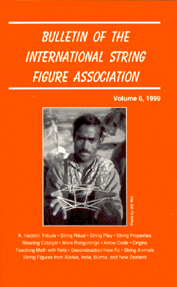
Tribute
- Kathleen Haddon (1888-1961), by Henry Rishbeth, Southampton, England, (pages 1-16) - Kathleen Haddon's three popular books inspired a whole generation of string figure enthusiasts. She also authored several fine papers published in leading anthropological journals. This tribute, written by her son, includes a biography and a survey of her publications.
Commentary
- Ritual for a String Master, by Sam Cannarozzi Yada, Parcieux, France, (pages 17-20) - Long before they became anthropological baubles, string figures were "performed." In this fanciful article, professional storyteller Sam Cannarozzi Yada pays tribute to shamans and other tribal elders who once used string figures as magical props for telling tales.
- Toby in Dreamtime A string-figure play from the Spectral Theater , by Tim Kennedy, Moorhead, Minnesota, (pages 21-39) - As a film student in the early 1980s, Tim Kennedy's initial attraction to string figures was as a form of primitive cinema portraying cultural cosmology. His string figure plays survive today as part of the 'Spectral Theater', a performance series that also features film screenings, shadow plays, and other para-cinema events. "Toby in Dreamtime" is a story he wrote to accompany forty-nine of his most favorite string figures.
Reviews
- String How its properties affect string figures, by Michael D. Meredith, Amarillo, Texas, (pages 40-46) - Beginners often complain that their string figures "collapse" or fail to resemble the beautiful illustrations provided by authors. In many cases the wrong type of string is being used. In other cases the loop dimensions are wrong. In this article the author offers advice on how to optimize string properties. Effective use of color is also discussed.
- String Figures and the Language Arts, by Barbara O'Rand and Audrey Collinson Small, Paradise, California, (pages 47-55) - Remedial reading teachers usually try to maintain a spirit of optimism, a spirit of enthusiasm about children overcoming their reading problems. The reading teacher diagnoses the students' problems and recommends courses of action to solve them. Sometimes there is an intangible spark missing in the whole process. The child sits and fidgets with his hands, the reading process seems so far removed from his interests. This article describes a creative supplementary approach used in the classroom as a catalyst between the classroom language arts, and the writing and reading arts, designed to stimulate interest, enhance self-concept and improve reading. To achieve this, it used the age-old practice of making string figures.
Research Reports
- Polynesian String Figures and Rongorongo: More Parallels, by Sergei V. Rjabchikov, Krasnodar, Russia, (pages 56-62) - Based on historic accounts, it is known that Easter Island string figures (kai-kai) were intimately associated with the island's famous writing system (rongorongo): pupils enhanced their memory skills by learning to make string figures, then proceeded to learn the rongorongo script. In this article I compare string figure design motifs from New Zealand, Tuamotus and Easter Island with rongorongo glyphs as a new evidence that in ancient times, this script may have been known throughout Polynesia.
- An Arrow Code for Recording String Figures, by George Bennet, Wymondham, Norfolk, England, (pages 63-95) - I have developed this code for recording string figures over a period of 60 years. Its essence is the use of arrows and position on the line of writing for specifying finger movements and strings. Initially the Arrow Code was for use in my personal notebook. But when other people wanted to join in, it had to be greatly simplified. In its present form it retains only a small stock of symbols, and most of these are intuitively obvious. The advent of word processors changed the picture yet again because of the need for records to be typed using the available stock of symbols. But this has also made it possible to internationalise the Code by providing usable symbols in place of the initial letters of English words I had employed previously. However, I continue to use phrases in plain language where this is simpler than complicated symbolic representations. I put these phrases in English; but these are readily translated into any other language without affecting the basic Code. There have been a number of other ways devised for recording string figures; and I compare my Arrow Code with several of these. Some of them are certainly more precise and scientific than mine, but this also makes them more complex and difficult to use. My aim has been to produce a Code that is as far as possible instantly clear and legible. This paper concludes with a number of examples illustrating the brevity and versatility of the Arrow Code. I offer it to the String Figure Community as a tool for the better development and sharing of their art.
- String Figures from Southwest Alaska, by David Titus, Lawton, Oklahoma, and Mark Sherman, Pasadena, California, (pages 96-112) - In this article revised methods for making nine Inuit string figures gathered by George Byron Gordon in 1907 are presented. The figures were gathered at Mamtrelich, a village on the Kuskokwim River in southwest Alaska.
- String Figures from the Indian States of Gujarat and Orissa, by Will Wirt, Port Angeles, Washington, (pages 113-132) - Very few string figures have been recorded from India. This paper describes a number of string figures and tricks collected in 1999 from the Indian states of Gujarat and Orissa.
- String Figures and Tricks from the Assam-Burma Border, by Alex Johnston Abraham, East Sussex, England, (pages 133-144) - In this article the author presents two string figures and six string tricks he gathered in 1943 among the Lushai while stationed in the mountainous region that divides Assam and Burma (the Lushai Hills, now called Mizoram). These are compared to a small collection gathered by H.E. Kauffmann among the Thadou Kuki, a closely related tribe living in the hills of Manipur, just north of Mizoram.
- String Figures from Burma, by James Hornell (1865-1949), (pages 145-148) - Four string figures from Burma (Myanmar) are described. The figures were gathered from Karen informants, the Karen being a minority group of Thai-Chinese origin. Although all four figures are known in India, only two are made using identical methods.
- Sinhalese String Figures and Tricks, by James Hornell (1865-1949), (pages 149-153) - One string figure and two string tricks from Sri Lanka (Ceylon) are described. All three have Indian counterparts.
- Maori String Figures, by Carey C.K. Smith, Stratford, New Zealand, (pages 154-160) - String figure repertoires are dynamic entities that change as cultures interact. In this article the author presents five string figures he collected in 1980 from a Maori girl of New Zealand. Only one appears in Andersen's Maori collection made in 1920. The other four are known elsewhere, and probably entered the Maori repertoire in recent times.
- Using String Figures to Teach Math Skills Part 3: The North American Net System, by James R. Murphy (inoli), Whitestone, New York, (pages 160-211) - String figures are wonderful tools for introducing students to abstract written languages like those used in math. This article presents the third of four string figure "systems" developed by the author for teaching math students how to think in abstract terms. The weaving sequences of three parent figures the Inuit, Navaho, and Klamath Nets are first broken down into various phases. The author then illustrates how each of the phases can be altered, spliced, and iterated to add complexity and richness to the designs. In the final section, the author shows how to write and manipulate generalized formulas that capture the essence of each weaving sequence.
- The Origin of String Figures, by Martin Probert, Plymouth, England, (pages 212-252) - How string figures originated is a question never investigated, yet a satisfactory hypothesis might shed light upon a circumstance that so many writers have remarked upon, the occurrence of similar or identical figures in different major geographical areas. More than twenty well-known figures of wide distribution are analysed. The conclusion is reached that the figures of world-wide distribution are those most capable of independent invention.
- Fun with Newkirk 2 Deconstruction and analysis of a novel string figure, by Homer Sapiens, somewhere in California, (pages 253-260) - For many string figures described in the published literature the method of manufacture is unknown all that remains is a drawing, or a photograph of the finished pattern. In this article the author presents an algorithm for "undoing" a string figure in stages. When reversed, the algorithm provides a crude method of manufacture which the maker can refine by substituting common string manipulations. A string figure invented by Steve Newkirk is used as an example to illustrate the procedure.
Book and Video Reviews - by Mark A. Sherman (pages 265-269)
- Guy Mary-Rousseli re (1913-1994), by Charles Choque.
- String Fun with the Parables: Christian String Stories, Volume 1, (Video), by David Titus.
- Cat's Cradle: Activity Fun Pack, by Henderson Editors, illustrated by Tim Perkins.
- Fascinating String Figures, by International String Figure Association, illustrated by Mark A. Sherman and Joseph D'Antoni.
Modern String Figures
- Doubly-framed Double Ladder String Figures, by Kazuo Kamiya, Saitama, Japan, (pages 265-269) - In this paper the author presents some highly unusual variations of well-known two-, three-, and four-diamond string figures. The author shows how the individual strings of each design can be doubled without doubling the loop prior to making the figure. Furthermore, he shows how the frame strings can be multiplied independent of the strings that form the design.
- Brown Bear String Figures, by Kazuo Kamiya, Saitama, Japan, (pages 270-276) - 'Two Brown Bears' is a popular string figure among the Inuit of Alaska. In this article the author presents thirteen amusing variations of that figure.
- Elk String Figures, by Kazuo Kamiya, Saitama, Japan, (pages 277-279) - 'Two Elks' is a popular Klamath Indian string figure. In this article the author describes a new way to make it plus four variations.
- Caribou String Figures, by Kazuo Kamiya, Saitama, Japan, (pages 280-288) - 'Caribou' is a string figure known throughout the Arctic. In this article the author presents an entirely new way of making it, plus eighteen variations he created.
- Hearts and Triangles, by Tetsuo Sato, Kumamoto, Japan, (pages 289-292) - Shapes with curves are difficult to portray in a string figure. When loosely extended, the first string figure described in this article resembles a heart. The author shows how to form a large version of this figure artificially for presentation to an audience. A string figure featuring three triangles is also presented.
Letters to the Editor (pages 293-298)
- String Figures in Russia? - Sergei V. Rjabchikov, Krasnodar, Russia. A letter drawing attention to the similarity between 'knot-writing' of the ancient Russians and a stage in the manufacture of an Eskimo string figure.
- Mathematical Variations or World Figures? - Sam Cannarozzi Yada, Parcieux, France. The author discusses his preference for string figures derived from tribal sources versus those created by mathematicians.
- Moving Mountains - Joseph D'Antoni, Queens, New York. The author explains how to better extend the final design of 'Kayaker and the Mountains', a series he presented in the September 1997 issue of String Figure Magazine. In an editoral reply, Mark Sherman corrects a mistake he made in describing how to make Gordon's 'Clothesline', published in Bulletin 3 ('Clothesline' is closely related to 'Mountains').
- Even With No Fingers You Can Make Lizard - David Titus, Lawton, Oklahoma. The author describes his recent experiences in western Nepal where he visited a leper colony and taught string figures. A string figure from Bhutan is also described.
- The Real Origin of Cat's Cradle - Philip Noble. The author argues that the term "Cat's Cradle" refers to a crib once popular in Scotland. The crib had six brass knobs on its frame. String was wound around the knobs to form a web that kept the baby safe from cats jumping in on it.
Table of Contents - Volume 7 (2000): 366 pages
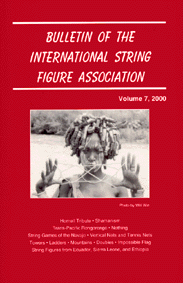
Tribute
- A Tribute to James Hornell (1865-1949), by David Heppell, Gibsons, British Columbia, and Mark Sherman, Pasadena, California (pages 1-56) - When James Hornell died in 1949 obituaries appeared in several newspapers and nearly a dozen scientific journals, each devoted to a different subject (natural history, marine zoology, Polynesian studies, anthropology, and seamanship). As a young man Hornell was a marine zoologist, but later became a fisheries expert, folklorist, and ethnographer. In his post-retirement years he was widely acknowledged as the world's foremost authority on primitive watercraft: his three-volume monograph "Canoes of Oceania" (Bishop Museum, 1936-38), coauthored with A.C. Haddon, remains a classic to this day. But James Hornell also collected string figures hence the tribute here. Thanks to Hornell's keen abilities we now enjoy collections from Africa (Sierra Leone, Liberia, Madagascar, the Sudan), Asia (India, Sri Lanka, and Burma), and the Pacific Islands (Fiji, Tonga, Samoa, and Tahiti among others). Who was Hornell? What were his special skills, and how did these skills uniquely qualify him to record string figures and tricks? What were the circumstances that led to such extensive travel? What is significant about his published works on string figures? These are the sorts of questions that will be addressed in this tribute.
Commentary
- String Figures and Shamanism, by Lois Stokes, Kauai, Hawaii, photographs by Earl Stokes (pages 57-65) - Are string figures just a child's game? In this article, Lois Stokes asks you to consider the idea that "the world is what you think it is." Perhaps string figures are more, much more than child's play.
Research Reports
- An Easter Island String Figure and Rongorongo Records Demonstrate Trans-Pacific Contact, by Sergei V. Rjabchikov, Krasnodar, Russia, (pages 66-70) - Most scholars believe that Easter Islanders are Polynesians, having arrived from the west. Yet some plants, including the South American sweet potato, clearly arrived from the East. In this article the author presents data suggesting that certain rongorongo glyphs, when translated into Rapanui, are words mentioned in a chant that accompanies a traditional Easter Island string figure. Furthermore, some of these words are borrowed from the language spoken by Quechua Indians of Peru, thus supporting the theory that trans-Pacific contact occurred prior to European discovery of the island. Several other lexical parallels between Quechua and Polynesian languages are examined.
- Nothing: A Series of String Figures Taught to Me by Elsie Sperry, by Audrey Collinson Small, Paradise, California, (pages 71-84) - Little is known about the string figures once made by American immigrants arriving from England and Europe in the early 19th century. In this article the author describes a string figure series that appears to date from this period. Of special interest is the fact that the series is reversible. The author explores the cultural significance of the names assigned to each design.
- Some String Figures and Tricks of the Quichua Indians of Ecuador, by Dominique Irvine and Alex Johnston Abraham, East Sussex, England, (pages 85-93) - Little is known about the string figures and tricks once made by the Indians of Ecuador. In this report the authors present four string figures and four string tricks gathered in 1984 among the Quichua Indians of Provincia Napo. Of particular interest is a two-diamond figure made upon the feet.
- Some String Figures and Tricks from Sierra Leone and
the Gold Coast, by Carey C. K. Smith, Stratford, New Zealand,(pages 94-100) - When James Hornell visited Sierra Leone in 1928 he recorded several dozen string figures from natives of several different tribes. He also observed many string tricks, but these did not appear in his published report. In this article, the author describes three string figures and one trick which he gathered in Sierra Leone fifteen years after Hornell's visit. In each case, the names and methods associated with each figure are nearly identical to those reported by Hornell, thus underscoring the fact that string figures are often stable elements of material culture. A string trick from the Gold Coast (Ghana) is also described.
- String Figures from Southwestern Ethiopia, by Will Wirt, Port Angeles, Washington, (pages 101-118) - String figures are a popular form of recreation in southwestern Ethiopia. This article describes figures collected there from Karo, Mursi, and Ari tribal members and from nontribal sources.
- String Games of the Navajo, by Will Wirt, Port Angeles, Washington and Mark Sherman, Pasadena, California; Cultural notes contributed by Mike Mitchell, Rough Rock, Arizona, (pages 119-214) - In this article the authors describe seventy-four string figures and tricks known to the Navajo Indians of Arizona. Methods for making sixty of these were gathered during the winter of 1999-2000 on a series of visits to the Navajo reservation. Thirty-four of these are new additions to the published literature on Navajo string games. Remarkably, methods for twenty of the twenty-seven Navajo string figures gathered by Caroline Furness Jayne nearly a century ago were still remembered, suggesting that string games are a stable element of Navajo material culture. The significance of string games among the Navajo is examined in an appendix to this article.
- Using String Figures to Teach Math Skills Part 4: Vertical Nets and Tennis Nets, by James R. Murphy (inoli), Whitestone, New York, (pages 215-287) - Today string figures are often viewed as useless relics of pre-literate societies. Few scholars appreciate the role they once played in the development of analytical thinking skills. In this article the author presents the last two string figure "systems" he uses to teach math skills to reluctant students. In the 'Vertical Net' system complexity is generated by iteratively weaving multiple loops stacked on the index fingers. In the 'Tennis Net' system loops are "braided" to generate highly ornate designs that rival the classic mesh figures of Pacific Islanders. A symbolic "circle notation" for recording the intricate moves is also introduced.
- The Towers of Hanoi: Combining Ribs with Storm Clouds, by
Frank J. Oteri, New York, New York (pages 287-295) - In the early 1900s Caroline Furness Jayne recorded methods for making two highly unique Navaho string figures. 'Storm Clouds' is an excellent example of a string figure whose weaving sequence can be "iterated" over and over to add new design units to the final pattern. 'Breastbone and Ribs' is a remarkably realistic figure that begins with four loops stacked on the index fingers. In this article the author shows how the iterative weaving sequence of 'Storm Clouds' can be borrowed and applied to 'Breastbone and Ribs.' The result is a design that features a series of terraced pyramids or "pagodas." This design resembles a famous mathematical puzzle called the 'Tower of Hanoi.'
- Doubly-Framed Ladder String Figures with Mixed Junctions, by
Kazuo Kamiya, Saitama, Japan,(pages 296-309) - In this article the author presents a highly innovative technique for making doubly-framed ladder (diamond) string figures with different types of string intersections between each diamond. Three types of intersections or junctions are defined: no interlock (a simple crossing); single interlock; and double interlock. The author shows how multi-step ladders with a limited number of different junction combinations can be assembled by simply combining the appropriate weaving units.
- Mountain String Figures, by Kazuo Kamiya, Saitama, Japan, (pages 310-315) - 'The Mountains' is a traditional Alaskan Inuit string figure featuring four peaks. In this article the author describes a way to make any number of mountain peaks. Both one- and two-loop versions are described.
Modern String Figures
- Double Navaho String Figures,by Kazuo Kamiya, Saitama, Japan, (pages 316-327) - Given two loops on the same finger, the string figure command 'Navaho' means "lift the lower loop over the upper loop and release it." This move is so named because it is frequently used by Navaho Indians of the American Southwest when making string figures. The term 'Double Navaho' is rather new. It means "move the lower loop to the upper position, then Navaho the two loops." In this article the author demonstrates how this technique can be used to create many amusing designs. The article ends with a series of string figures that illustrates the well-known fable "The Tortoise and the Hare."
- Double Caribou String Figures, by Kazuo Kamiya, Saitama, Japan, (pages 328-335) - The Inuit are fond of making single and double versions of various animal string figures. For example, in Jenness's monograph on Alaskan string figures methods for making 'One Mammoth' and 'Two Mammoths' are given (Jenness 1924:43B, 44B). But a double version of 'Caribou' is lacking. In this article the author presents two methods for making 'Two Caribou'. Eleven variations representing various animals are also described.
- A Number, Some Letters, and Mercedes Benz Logo: Five amusing string figures, by Kazuo Kamiya, Saitama, Japan, (pages 336-338) - The five string figures described in this short article are displayed using a novel method of extension that facilitates the presentation of curving lines.
- Some Simple String Polyhedra, by Tetsuo Sato, Kumamoto, Japan, (pages 339-342) - Cube, tetrahedron, and octahedron are three-dimensional shapes familiar to anyone who studies science or math. Their symmetries are pleasing to the eye. In this article the author describes how to make these three shapes using a loop of string. The figures are easily adapted for large scale presentation to an audience.
- Olympic Flag: An Impossible String Figure, by Tetsuo Sato, Kumamoto, Japan, (pages 343-345) - In this article the author presents 'Olympic Flag' a rectangular string figure that features five linked rings. Although novel, this string figure is actually a complex knot. Yet its method of manufacture is remarkably simple.
Book and Video Reviews - by Belinda Holbrook, Will Wirt, and Mark Sherman (pages 346-352)
- Lost! A Story in String, by Paul Fleischman.
- Pull the Other One! String Games and Stories, by Michael Taylor.
- By Hook or by Book, by D. R. Meredith.
- Lustige Fadenspiele: Fingerspiele f r alle, by Anne Akers Johnson.
- Das Hexenspiel: Finger-Fadenspiele neu entdeckt, by J. Ellfers and M. Schuyt.
- Fadenspiele: Zaubereien mit der Schur, by Camilla Gryski.
- Die sch nsten Fadenspiele, by Camilla Gryski.
- Die sch nsten Fadenspiele aus aller Welt! by G nter Frorath.
- Alte und Neue Fadenspiele f r hurtige Finger, by Lena Wellnhofer.
- String Figure Bibliography, 3rd Edition, by the International String Figure Association (edited by Tom Storer).
Letters to the Editor (pages 353-356)
- The Real Origin of Cat's Cradle, Part 2 - Philip Noble. The author continues to argue that the term "Cat's Cradle" refers to a crib once popular in Scotland. The crib had six brass knobs on its frame. String was wound around the knobs to form a web that kept the baby safe from cats jumping in on it. A photo is offered as evidence.
- Regarding "The Real Origin of Cat's Cradle" - A. Johnston Abraham. The author argues that the term "Cat's Cradle" is a nautical term referring to a net made of rope for "catting" (storing) a ship's anchor.
- Angel, Diamond, and X - Pat Whale. Three simple variations of figures appearing in Jayne's book are offered.
- The House of Nikolaus - Axel Reichert. A string figure that resembles a popular German pencil and paper puzzle is described.
Nomenclature (pages 357-365)
- Abbreviations and terms used throughout the Bulletin are summarized and illustrated. Step-by-step illustrations for making two string figures (Binary Stars and Boomerang) are provided as examples.
Erratum (page 366)
- A mistake in Bulletin 6 is noted.
Table of Contents - Volume 8 (2001): 334 pages
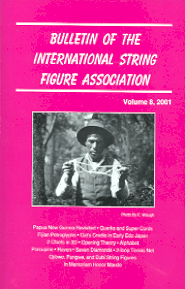
Commentary
- Papua New Guinea Revisited: An autobiographical account of
recent encounters with old string figure friends, by Philip D. Noble, Prestwick, Ayrshire, Scotland, (pages 1-15) - In the mid-1970s Anglican missionary Philip Noble spent three years in the Musa and Managala districts of Papua New Guinea where he managed to collect 140 string figures and tricks. His impressive collection was published in 1979 by the Institute of Papua New Guinea Studies in Boroko. Late last year (December 1-17, 2000) he returned to Papua New Guinea for the first time since his missionary days. In this colorful narrative the author describes his interactions with previous informants and provides an update on the status of string figures in Papua New Guinea at the beginning of the new millennium. Instructions for making four new string figures are also given.
- Of String Figures, Quarks, and Super Cords by Sam Cannarozzi Yada, Parcieux, France, (pages 16-20) - String theory has been around since the 1960s, but did not gain wide acceptance until 1984 when a key mathematical problem was solved. Also known as "the theory of everything," string theory attempts to reconcile two conflicting disciplines: quantum mechanics, which describes the behavior of subatomic particles, and Einstein's theory of relativity, which deals with space, time, and gravity. Problems arise when physicists try to apply Einstein's theory to small distances (the realm of subatomic particles). String theory reconciles the two by postulating that photons, gluons, and other small building blocks of the universe are generated by one-dimensional strings that vibrate in all possible dimensions. In this article the author explores parallels between modern string theory and ancient games played with string.
Research Reports
- Cat's Cradle in the Literature of Early Edo Japan, by Yukio Shishido, Kyoto, Japan, (pages 21-38) - The earliest reference to cat's cradle in English literature dates from 1768, but in Japanese literature references appear as early as 1665. Additional references dating from the Early Edo period (1603-1750) suggest that cat's cradle was considered an elegant game for Japanese girls during this era. It remains popular to this day. In this article the author surveys various references to cat's cradle in poems, novels, and picture books of Early Edo Japan.
- Fijian and Polynesian String Figures Help Decipher Fijian Petroglyphs, by Sergei V. Rjabchikov, Krasnodar, Russia, (pages 39-45) - In this article I examine Fijian and Polynesian string figures and compare them to Polynesian art. The parallels allow me to draw attention to striking correspondences between mysterious Fijian petroglyphs and Easter Island (Rapa Nui) rongorongo glyphs. In addition, new evidence of trans-Pacific contact is offered.
- Ojibwe String Figures and Tricks, collected by Frederick W. Waugh (1872-1924), edited and illustrated by Mark Sherman, Pasadena, California, (pages 46-124) - Frederick Waugh's recently discovered Ojibwe collection provides us with our first in-depth look at string figures and tricks once known to Native Americans living east of the Rockies. The collection consists of 23 string figures and 10 tricks gathered among the Northern Ojibwe of Long Lake, Ontario, and the Saulteaux of Lac Seul over eighty years ago (1916-1920). It is the first major collection ever published from an Algonquian-speaking tribe. Like most string figure repertoires, the Ojibwe repertoire consists of a handful of core figures accompanied by variations. The majority of figures are unique, but clearly related to figures known elsewhere in North America, especially those of the American Southwest. The repertoire also includes a few tricks that have not been previously recorded, which is surprising since most string tricks are globally distributed.
- Pangwe and Bubi String Figures, collected by G nter Tessmann, translated by Axel Reichert, Bad Oldesloe, Germany, annotated and illustrated by Mark Sherman, Pasadena, California, (pages 125-201) - Between 1907 and 1909 German-born ethnographer G nter Tessmann gathered thirty-nine string figures and one string trick from the Pangwe (Fang peoples) of modern day Cameroon, Equatorial Guinea, and Gabon. In 1915-16 he collected four figures and three tricks from the Bubi of Fernando Poo (now called Boiko Island). In 1912 his Pangwe collection was published in the journal Baessler Archiv. His Bubi collection appeared in a book published in 1923. Unfortunately, both collections have remained inaccessible to most string figure enthusiasts because the instructions are written in German and illustrations are lacking for the majority of figures. In this article, the authors offer an English translation. Illustrations and supplemental notes are also provided.
- Two Chiefs in 3-D: Toward a general theory of three
dimensional string figures, by Frank J. Oteri, New York, New York, (pages 202-210) - In her classic book Caroline Furness Jayne published instructions for making a two-dimensional Micronesian string figure called 'Two Chiefs.' In this article the author presents a simplified method that begins with a two-loop loom. He then describes how to iterate a portion of the weaving sequence to give any number of Chiefs, and shows how a three-dimensional analog of that figure can be made by altering the initial loom. The author suggests that his overall approach might prove useful in making iterative, 3-D analogs of other simple string figures that begin with a two-loop loom.
- Using String Figures to Teach Math Skills Part 5: Opening Theory, by James R. Murphy (inoli), New York, New York, (pages 211-234) - String figures are excellent tools for helping students acquire spatial skills. They also promote analytical thinking when taught systematically. In this article the author presents yet another system he uses to teach math skills to students who do not respond to traditional methods of learning. Two spatial concepts, chirality and asymmetry, are explored through systematic variation of a simple string figure.
Modern String Figures
- A String Figure Alphabet, by Carey C.K. Smith, Stratford, New Zealand, (pages 235-255) - Most traditional string figures were created by preliterate peoples of the world. Nevertheless, some of their designs resemble letters of the alphabet. In this article the author combines these figures with some of his own to form a complete alphabet.
- Porcupine String Figures, by Kazuo Kamiya, Saitama, Japan, (pages 256-273) - 'Porcupine' is a traditional North American string figure known to Indians and Inuit alike. In this article the author introduces a new method for making 'Porcupine' plus eight variations. The variations represent various animals, including a dog, a cat, and a caribou. Methods for making double versions of each are also given. All the figures in this article are described using a new shorthand notational system devised by the author.
- Raven String Figures, by Kazuo Kamiya, Saitama, Japan, (pages 274-284) - 'Raven' is an Inuit string figure known throughout the Arctic regions of Alaska, Canada, and Greenland. In this article the author introduces two new methods for making 'Raven' plus thirteen novel variations. The variations represent various animals (dog, pony, flying crane, dove, and swan) plus various numbers (1, 2, 4, 6, and 9).
- Seven Diamond String Figures, by Kazuo Kamiya, Saitama, Japan, (pages 285-315) - 'Seven Diamonds' is a classic net figure that is easy to make. In this article the author examines the many ways in which 'Seven Diamonds' can be made. He then shows how variation leads to nets with five, thirteen, fourteen, twenty-one, and twenty-five diamonds. A method for doubling the frame string is also given.
- Tennis Net with Two Loops, by Tetsuo Sato, Kumamoto, Japan, (pages 316-320) - The use of two loops when making string figures greatly increases the number of possible manipulations. The resulting designs are potentially more intricate and beautiful, especially when loops of different colors are used. In this article the author presents a two-loop version of Murphy's '4-loop Tennis Net', an elaborate mesh that appeared in last year's Bulletin.
Obituary
- In Memoriam Honor Maude (1905-2001), by Alaric Maude, Adelaide, Australia, (pages 321-324).
Book Review - by Mark Sherman (pages 325-326)
- Ficelles, by Daniel Picon.
Letters to the Editor (pages 327-334)
- Impossible Flag Possible - Ron C. Read. In last year's Bulletin Tetsuo Sato gave us 'The Olympic Flag', described as "an impossible string figure." His ingenious method of construction involves cutting and tying the string. But if we eliminate the requirement that the frame strings must be transverse, the impossible flag is indeed possible! The author provides a construction method.
- A Helping Hand - Philip D. Noble. The author describes a heart-warming encounter he had with a Norwegian submarine officer who had lost an arm many years ago. Together they were able to do a string trick the officer learned while serving in the Navy. The author provides illustrated instructions.
- Mongolia: Land of 15,000 Strings - David Titus. The author describes a recent trip to Mongolia where he distributed thousands of colorful string loops and learned a few Mongolian string figures and tricks, all of which have been seen elsewhere.
- Half-second Star - Bob Grimes. The author provides instructions for making a simple star-shaped string figure that requires only 'half-a-second' to form.
- Ladder Patter - Mary Beth Andersen. Verbal cues are helpful when teaching children how to make string figures. The author presents her "patter" for teaching 'Jacob's Ladder' to kids.
- Sensation: Russian Pupils Played String Games in 1970s
- Sergei V. Rjabchikov. The Cat's Cradle series was indeed known in Russia. The author provides names and illustrations of some of the designs shown to him by several women.
Table of Contents - Volume 9 (2002): 366 pages
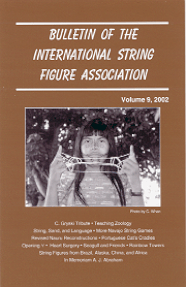
Tribute
- A Conversation with Camilla Gryski: Canada s "String Lady", by Mark Sherman, Pasadena, California, (pages 1-54) - This article features a biography of Camilla Gryski, a survey of her nine published books, plus a transcript of an interview conducted in April 2001.
Commentary
- "Very Like a Lamprey": How String Figures Add Entertainment Value to Science Lectures, by Michael Pollock, Calgary, Alberta, Canada, (pages 55-68) - In ancient times story tellers used string figures to enhance their narratives. Today zoology professor Michael Pollock uses string figures to enliven his rather dry 8 AM vertebrate taxonomy lectures. Students appreciate the effort he makes to capture their attention. His strategy is outlined in the following essay.
- String Figures, Sand Paintings, and Language -- Are they linked?, by Sam Cannarozzi-Yada, Parcieux, France, (pages 69-72) - In this short essay the author examnines parallels between string figures, Navajo sandpaintings, Vanuatu ululan (geometric drawings traced in the sand), and mandalas (meditative sand paintings) made by Tibetan monks. Language parallels are also examined.
Research Reports
- String Games of the Navajo, Part 2: Supplemental Notes and Additional Figures, by Mark Sherman, Pasadena, California, and Will Wirt, Port Angeles, Washington, (pages 73-150) - In our last article we described 56 string figures and 4 string tricks gathered among the Navajo Indians of Arizona during the winter of 1999-2000. The article also included 14 string figures published by Jayne nearly a century ago. In this article we offer additional information gathered during the winter of 2001. This information includes a table that summarizes the prevalence of each game at 12 different locations on the reservation (5 of which were surveyed for the first time in 2001), alternative titles for many of the previously gathered figures, and 41 new games, most of which are variations of previously collected games. This article also includes a highly detailed analysis of subtle differences in technique observed among 50 informants who were asked to perform figures from the standard Navajo repertoire. The analysis suggests that there is no single "correct" way to form many of the figures.
- Reru: String Figures of the Brazilian Karaj Indians, by Chang Whan, Niter i, RJ, Brazil, (pages 151-185) - The present article reports the results of the research conducted by the author on the string figure making activity observed among the Karaj Indians in Brazil between the years 1996 and 1998, as part of the requirements needed for the M.A. degree in Anthropology of Art at the Federal University of Rio de Janeiro. A total of 50 string figures were photographed. Methods for making 28 are presented in this article.
- Xema e wa:String Games among the Tapirap Indians of Brazil, by Luiz Gouv a de Paula and Eunice Dias de Paula, Goi nia, Brazil, (pages 186-202) - In this article the authors document 40 string figures gathered among the Tapirap Indians of Mato Grosso, Brazil, during April of 1986. For each design the authors were able to secure a mounted specimen and record the native name, but no methods of manufacture were obtained. However, many of the designs are identical or similar to designs collected among the neighboring Karaj Indians, for which the method of manufacture is known (see the preceding article in this volume).
- Yup ik String Figures, by David Nicolai, Anchorage, Alaska, (pages 203-234) - Anthropologists visiting Alaska early in the twentieth century were fascinated by the intricate string figures shown to them by Yup ik and Inupiaq people. With the distractions of modern society, the skills required to make these figures have often been lost. Fortunately a few families are keeping the tradition alive by passing on their knowledge to younger generations. In this article David Nicolai describes 42 Yup ik string figures learned from his father and grandmother.
- More String Figures from China, by Will Wirt, Port Angeles, Washington, (pages 235-240) - In 1997 Will Wirt collected 28 string figures and 4 tricks while visiting the Yunnan Province and Beijing Municipality in China, and the city of Lhasa in Tibet. His collection, published in volume 5 of this journal, provided the West with its first glimpse of string games from this region. In this article the author describes three additional figures he collected on a return visit in 2001.
- Some String Figures from Modern Africa, by Axel Reichert, Bad Oldesloe, Germany, (pages 241-248) - In this article the author describes methods for making several string figures and tricks he gathered in the African pavilion at EXPO2000, a world exposition held in Hannover, Germany two years ago. His informants were from Nigeria, Mauretania, Mali, and Madagascar. Most are identical or closely related to African figures first collected over 60 years ago.
- Revised Reconstructions for some Nauruan String Figures, by John Kean, Lincoln, New Zealand, Joseph D Antoni, Queens, New York, Mark Sherman, Pasadena, California, and Yukio Shishido, Kyoto, Japan, (pages 249-261) - We present several new constructions for the Nauruan string figures Domaneab (Meeting House), Cantilever Jetty, and Aom (Hermit Crab). While the former are the more complicated designs, the latter presents perhaps the greater challenge to those seeking reconstructions. For, although we present no less than six different reconstructions for Aom, detailed analysis suggests that we cannot be sure which method is best, nor even if we have reconstructed the correct figure. The Nauruan string figures continue to surprise and challenge, almost a century after they came to the attention of the Western world.
- Cat s Cradle in Portugal, by Paulo Escudeiro, Cacem, Portugal, (pages 262-284) - Cat s Cradle, a two-player series that apparently originated in China or Japan, is now enjoyed worldwide. However, the sequence of designs often varies from country to country. In this article the author describes seven different sequences he observed among school children in Lisbon. According to the author new designs are often created spontaneously. Of special note are several asymmetrical designs not reported previously.
- Is This String Figure Possible?, by Joseph D Antoni, Queens, New York, (pages 285-293) - This article explores a method of altering the string crossings of a finished string figure into a new pattern, then testing the new pattern to see if it can actually be constructed from a simple string loop.
- Opening ∀, by Joe Ornstein, New York, New York, (pages 294-306) - Opening A is the most ubiquitous opening in all the string figure world. Its simplicity and symmetry on the fingers has a natural appeal from which flows many a string figure. But in a strange way Opening A can sometimes stifle creativity. Use Opening A too much, and the mind can become locked into thinking about finger manipulations and string movements in limited ways. Thinking outside the box becomes difficult. New openings give birth to new string realities to explore with ten fingers, two hands, and a loop of string. Antipodal A is just such an opening.
- Using String Figures to Teach Math Skills - Part 6: Fun with Opening ∀, by James R. Murphy (inoli), New York, New York, (pages 307-319) - In previous articles the author has explored various string figure "systems" suitable for teaching math students how to think logically and better comprehend various fundamental math concepts such as reciprocals, additive inverses, matrices, iterations, generalized formulas, chirality, asymmetry. By learning to create and symbolically notate new string figures students overcome their math shyness. In this playful article the author exhibits his acquired skills by showing how a new string figure opening can be systematically manipulated to create a series of beautiful new designs. Several net figures with a "heart" embedded in the web are of special interest.
Modern String Figures
- Seagull, Water Bucket, and Fawn String Figures, by Kazuo Kamiya, Saitama, Japan, (pages 320-344) - 'Seagull', 'Two Men Carrying Water Buckets', and 'Two Fawns' are traditional Inuit string figures whose methods of construction are related. In this article the author introduces new methods for making each of them plus 18 variations. The variations represent various animals such as eagles, dogs, rabbits, and giraffes. All the figures in this article are described using a shorthand notational system devised by the author.
- Rainbow Towers of Hanoi: A multi-loop version of a recently invented string figure, by Tetsuo Sato, Kumamoto, Japan, (pages 345-349) - 'Towers of Hanoi' is a modern string figure invented by Frank Oteri of New York. It resembles a classic mathematical puzzle of the same name. In this article the author shows how to make a multi-colored version of this stunning new figure using multiple loops.
Obituary
- In Memoriam Alexander Johnston Abraham (1915-2002), by Sally Abraham, Vancouver, British Columbia, Canada, (pages 350-351) - The life of a prominent string figure author is summarized by his daughter.
Book Reviews - by Joseph D'Antoni, Mark Sherman, and Axel Reichert (pages 352-357)
- He Whai: Old and New String Figures from Aotearoa New Zealand, by Briar O Connor and Libby Patterson.
- For Children: How to Make String Figures, by Hen (Hsian) Lung Yu (written in Chinese).
- Now you see it String Games and Stories - Book 2, by Michael Taylor.
- Fadenspiele sind mehr!: Fadenfiguren spielen und Geschichten erz hlen (String Games are More!: String Figures to Play and Stories to Tell), by Lothar Walschik (ABOINUDI)
- The String Figures of Nauru Island, by Honor Maude with members of the International String Figure Association. Second edition, revised and expanded.
Errata (pages 358-359)
- The String Figures of Nauru Island, 2nd Edition, 1st press run (late 2001) - Many of the errata listed here were corrected in the second press run (mid-2002). Unfortunately the first press run (mid-2001) suffered from numerous printing and computer errors, most of which were corrected in the second press run (early 2002). However, a significant number of copies from the first press run were sold before the errors were noticed. If the last page of your copy is blank, it is from the second press run and you need not worry.
Letters to the Editor (pages 360-366)
- The Overlooked Extension - John Kean. Many string figures are displayed on the hands between a pair of transverse "frame" strings, which typically lie across the near side of the thumbs and the far side of the little fingers prior to extension. In this letter to author draws attention to an uncommon technique used by Maori string figure artists (in making the design called Kotiro-Punarua to stabilize the frame lines and optimize the symmetry of the pattern.
- Belize, Please - David Titus. Figures and tricks observed on a recent visit to Belize in Central America are described.
- Diamonds from South Africa - David Titus. Figures and tricks observed on a recent visit to South Africa are described.
- Quarks & Super Strings: Actions and re-Actions - Sam Cannarozzi Yada. In the 8th Bulletin of the ISFA (2001), I had whimsically written an article proposing comparisons between string figures and quantum physics. To my delighted surprise, lo and behold, I received encouragement for my musing from not only an ISFA member, but a member who is as well a scientist of high atmosphere physics AND the son of one of the most prestigious precursors of string figure collecting and research: Dr. Henry Rishbeth, son of Kathleen Haddon.
- Kiwi - One or Two? - Carey C.K. Smith. Whether or not this string figure from New Zealand represents one or two Kiwis is debated.
- The Saw I Saw in Greece - Yukio Shishido. A string figure photographed on the Island of Rhodes in 1978 is compared to a similar figure photographed in Athens in 1951.
Table of Contents - Volume 10 (2003): 288 pages
Tribute
- A Tribute to John Lyman Cox (1866-1955), by
Mark Sherman, Pasadena, California, (pages 1-60) - In her book entitled String Figures,
published in 1906, Caroline Furness Jayne describes how to make 97 string figures. Of these, 31
were collected by the author at the St. Louis Exposition in 1904. The remaining 66 figures were
gathered by others, including her mentor Dr. A.C. Haddon, her brother Dr. William Henry Furness III,
and Mr. John L. Cox of Philadelphia, whose relationship to the author is not stated. Indeed, some of
the most impressive string figures in her book are attributed to John Lyman Cox, who collected them
at the Indian School at Hampton, Virginia. Much is now known about Caroline Furness Jayne and her family
thanks to a biography written by Mike Meredith for our 1997 Bulletin, but who was John L. Cox,
and how did he know Mrs. Jayne? When, exactly, did he collect the figures at Hampton, and what became
of his informants? These questions remained unanswered until last year when James S. Cox, eldest
son of John L. Cox, contacted the ISFA seeking membership. In this tribute I share information
provided by JLC s son James, his daughter Mary, and his grandson John L. Cox, III. I also summarize
what is known about JLC s informants. An essay on string figures, written by daughter Mary Cox at
age 16, is offered as an appendix. Biographical information about other members of the Furness
and Jayne families is also included.
Commentary
- A Student's Notes on Tai Chi Chuan and String Figures, by Audrey Collinson Small, Chico, California, (pages
61-62) - The practice of Tai Chi Chuan and the making of string figures appear to have much in common in spite of some differences.
Both appeal to the kinesthetic sense of muscle, balance and heft. Both are ancient cultural forms involving movements of
the human body in relation to space. In this essay, the similarities and differences are examined.
Research Reports
- Mountain String Figures, by Joseph D'Antoni, Queens, New York, (pages 63-77) -
The Inuit string figure known as The Mountains consists of five triangles that represent
five mountain peaks. In this article the author presents a general method for creating mountain
string figures having any number of peaks. A method for effectively displaying the figure
on the hands is also offered.
- String Games of the Kangirsujuaq Inuit, by Bernard Saladin d'Anglure, Quebec City, Quebec, (pages 78-199) - During the
past century string figures have been gathered from nearly all Inuit groups except those of the Quebec-Labrador
peninsula. This lack of data has severely hampered attempts to compile a comprehensive catalog and map
the geographic distribution of each design. The collection described herein partially fills the void. The
57 Inuit string figures illustrated in this article were gathered by anthropologist Bernard Saladin d Anglure
in 1966 while doing field work at Kangirsujuaq (formerly Maricourt-Wakeham), a village located on Ungava
Bay in Nunavik, Quebec s arctic region. His informant, for all except the last two figures, was an Inuit
woman named Ilisapikutaaq. As each figure was made the author taped the finished pattern to a sheet of paper,
labeled the finger loops, and recorded the native name. Photocopies of each specimen are reproduced in this article.
Probable methods of construction are offered in an appendix.
- Street Cat's Cradle, by Paulo Escudeiro, Lisbon, Portugal, (pages
200-225) - Cat s Cradle is a widely known string game that requires two players. Instructional books
often imply that the goal of the game is to successfully make a series of traditional designs, typically eight.
Occasionally authors acknowledge that the original purpose of the game was to continue playing as long as
possible, which they illustrate by showing how designs from the middle or end of the series can be
transformed into one of the beginning designs in a seemingly endless fashion. In this article the
author describes how children play the game in the streets of Lisbon, Portugal, where it has become
a competitive sport accompanied by an elaborate series of rules and strategies for winning the game.
- Fun with Bokola, A Traditional String Figure from Fiji, by Joseph Ornstein, New York, New York;
Joseph D Antoni, Queens, New York; Mark Sherman, Pasadena, California; James Murphy, New York, New York (pages 226-255) -
Two major processes drive the evolution of string figures: technique sharing and friendly competition.
It is well established that new designs emerge when methods for making existing designs are altered.
But deciding how to alter a method requires special insight that can only be acquired through trial and
error, or from others. In this article four string figure artists collaborate to create novel variations
of Bokola, a traditional figure from Fiji. Each artist makes a unique contribution to the group by sharing
techniques gleaned from years of experience.
- Crocodile: A String Figure Series from Papua New Guinea, collected by
Hiroshi Noguchi, Tokyo, Japan; translated and introduced by Yukio Shishido, Kyoto, Japan. (pages 256-262) - In this
article the authors present instructions, translated into English, for making a string figure series from
Papua New Guinea called A Crocodile . As the maker performs a series of repetitive movements, the crocodile
is seen basking in the sun, opening his mouth, eating his prey, and taking a nap.
Book Reviews - by Joseph D'Antoni and Mark Sherman (pages 263-266)
- String Games, by Richard Darsie.
- String Stories: A Creative, Hands-on Approach for Engaging Children in Literature, by Belinda Holbrook.
- String Games, by Arvind Gupta.
- Native American String Figures, by David Titus.
Letters to the Editor (pages 267-274)
- A Moth - Kazuhiro Kawashima and Yukio Shishido. - Moth is a variation of the Inuit figure known as 'Seagull'.
It was invented by Kawashima in 1996.
- Twinkling Star - Avery Burns. A six-pointed star that 'twinkles' is offered by the author. The figure is a variation
of the Hawaiian figure 'The Twitcher'.
- Lawnmower and Belted Butterfly - Bob Grimes. This four-part series derives from 'Cup and Saucer'.
- The Real Towers of Hanoi - Joseph D'Antoni. Original version of Frank Oteri's instructions for making a figure comprised of multiple pagoda-shaped towers.
- Diamond Surplus in South Africa - Dave Titus. Brief report of string figures seen by the author on a recent visit to rural areas of
South Africa. Includes a technique for adding pairs of diamonds to any diamond figure.
Nomenclature - by Mark Sherman (pages 275-286)
- Abbreviations and terms used throughout the Bulletin are summarized and illustrated. Step-by-step illustrations for making three Inuit string figures (A Hill with Two Ponds, A Mammoth, A Paddle) are provided as examples.
Table of Contents - Volume 11 (2004): 288 pages
Special Issue
- Ayatori: The Traditional String Figures of Japan, by Tama Saito, Saitama, Japan, prepared for publication by Yukio Shishido, Kyoto, Japan, (pages 1-286) -
The Japanese have enjoyed playing string games for at least 340 years and probably much longer. During a series of field trips between 1970-1980, and at every opportunity that arose between 1981-1999, author Tama Saito traveled throughout Japan learning traditional string figures and tricks from anyone who was kind enough to teach her. After 30 years of tedious work her collection includes an astounding 274 methods, which she has chosen to publish here in English translation. For each figure or trick, the author provides the reader with informative cultural notes, an exhaustive list of titles, the location at which it was learned, the sex and age of the informant, and one or more artistic sketch made with brush, pen, and ink. Of special note is the author s comprehensive survey of the Japanese cat s cradle series, both the two-player version and the solo version. Four introductory chapters summarize the circumstances that allowed her to travel, her collecting experiences, the generic names her informants used in referring to string figures, and the rules they observed when playing cat s cradle. Appendix 1 presents 24 Japanese-style figures and methods invented by the author. Appendix 2 provides readers with maps of Japan showing the 47 prefectures mentioned in the text.
Volume 11, Japanese edition (2022): 308 pages
Corrected and revised by Mr. Kei'ichiro Ishino.

Table of Contents - Volume 12 (2005): 190 pages
Tribute
- Fifteen Years for Ayatori, by Hiroshi Noguchi, Tokyo, Japan (pages 1-56) -
An autobiographical account of Dr. Noguchi's 15 years as the first director of the ISFA. Profusely illustrated with photographs.
Interview
- Michael Kusugak: Weaver of Inuit String Stories, by Michael Pollock, Calgary, Alberta, Canada (pages 57-65) - When acclaimed Inuit storyteller Michael Kusugak visited Calgary s Glewbow Museum in 2003 he performed many of the traditional string figures he learned as a child at Repulse Bay in the Canadian Arctic. ISFA member Michael Pollock seized the opportunity to interview him.
Research Report
- Innu String Figures and Tricks, collected by Frederick W. Waugh (1872-1924), edited and illustrated by Mark Sherman, Pasadena, California (pages 66-147) - In 2001 the ISFA published an article on Ojibwe String Figures and Tricks gathered by Canadian ethnographer Frederick W. Waugh between 1916 and 1920. It was celebrated for being the first major Native American string figure collection ever made among a tribe that speaks an Algonquian language. Here we present yet another major collection that F. W. Waugh made while working among an Algonquian-speaking tribe, this being the Innu (Montagnais-Naskapi), a tribe that traditionally occupied the vast interior region of the Qu bec-Labrador peninsula. The collection, assembled at Sept- les (Seven Islands) during the summer of 1924, consists of twenty-five string figures and one string trick. Surprisingly, only a small percentage are similar or identical to figures gathered among the linguistically related Ojibwe, who live south of Innu territory: most are related to figures gathered among the linguistically unrelated Inuit (Eskimos), who live north of Innu territory.
Modern String Figures
- New Figures from the Ti Meta Opening, by Carey C.K. Smith, Stratford, New Zealand (pages 148-153) -
Retired physician Carey C.K Smith has been making string figures for over eighty years. In this short article he describes five new string figures he created that begin with an opening borrowed from a design that is widely distributed in the South Pacific Ti Meta (the Ti Bird s Nest).
- Fun with Suhurimae: Variations of a Solomon Islands String Figure, by Mark Sherman, Pasadena, California (pages 154-176) - Suhurimae is a novel Solomon Islands string figure that features an oval loop in the center. To express their fondness for this figure, the islanders created a variation which they called Porotoutouta a. Years later, Tom Storer created his own variation which he called Suhurime. In this article the author presents seventeen additional variations that he created to celebrate the retirement of his beloved mentor, Professor Tom Storer.
Book and DVD Reviews - by Mark Sherman (pages 177-183)
- Na atl o : Navajo String Games, by Don Mose, Jr.
- La Pita: Juego Ancestral, by Rub n Dar o Huapaya Amado.
- Ein Faden verbindet: Weltumspannende Fadenspiele, edited by Anka Bolduan, Heidemarie Menge, and Maren Rahlf.
- Hei: Hawaiian String Figures, performed by Lois and Earl Stokes. (DVD)
- Le Coeur du Singe: The Monkey s Heart (Anne Glover Raconte! Volume 1), by Anne Glover. (DVD)
- African String Figures, by David Titus.
Letters to the Editor (pages 184-190)
- Li, not Rii - Yukio Shishido. Comment about a photo published in ISFA Bulletin vol. 1 (1994).
- Laughing Jackass Gets the Last Laugh - Yukio Shishido. Comment about a string figure that appeared in String Figure Magazine (March 2000) which the editor misinterpreted.
- Kenshu, not Tatsuhide - Tetsuo Sato. Correction about an article that appeared in ISFA Bulletin vol. 3 (1996).
- Ladder Patter II - Bob Grimes. Second letter about mnemonic rhymes that help performers remember the steps in making Jacob's Ladder.
- Stamp-sized String Art - Carey C.K. Smith. Brief account of a miniature string figure that was presented to the author as a gift. It was woven with the help of two forks, whose tines served as fingers.
- Not just Whistling Dixie - Lynn Bacon-Trzcinski. Brief account of childhood string figures once known in rural Alabama.
- Stage Fright Advice - Camilla Gryski. Quick tips, gleaned from years of experience, on how to teach string figures to a large group of children.
- Toronto's String Legacy - Ken McCuaig. Recollections of Thomas McIlwraith, an anthropology Professor at the University of Toronto.
- Moose for a King - Lori King. Instructions for making an invented string figure that represents a Canadian moose.
Table of Contents - Volume 13 (2006): 190 pages
Special Issue
- The String Games and Cat s Cradles of Palau, collected by P. Raymund Laile, O. Cap.; translated by
Axel Reichert, Bad Oldesloe, Germany; distribution analysis by Joseph D'Antoni, Queens, New York; introduction and reconstructed methods by Mark Sherman, Pasadena, California (pages 1-163) - P. Raymund s massive collection of string figures from Palau was published nearly a century ago in the widely-read journal Anthropos (1911, Vol. 6, pages 40-61). It is an important article that documents a wide variety of complex and previously unrecorded designs from a region that is pivotal in understanding how string figures diffused across the globe. Nevertheless it has been largely ignored by the string figure community for two reasons: 1) the article is written in German; and 2) the author failed to collect methods for making the 101 designs he photographed. In this special issue the editors present an English translation of Raymund s article, reconstructed methods for making all the figures in the collection, and a preliminary distribution analysis. Based on the analysis, it appears that only thirty-eight of the designs in the collection have been recorded elsewhere in Oceania. The remaining sixty-three are either variations of previously observed figures or entirely new designs that were created by shuffling and combining well-known Oceanic technique sequences.
Nomenclature - by Mark Sherman (pages 164-190)
- Abbreviations and terms used throughout the Bulletin are summarized and illustrated. Step-by-step illustrations for making seven Oceanic string figures (Flower of the Tomano Tree, Papuan House, Fire and Smoke, Laughing Jackass, Crescent Moon, The Kiss, and Rat on a Roof) are provided as examples.
Table of Contents - Volume 14 (2007): 288 pages

Tribute
- Someone who Loved the String: A tribute to Tom Storer by Mark Sherman, Pasadena, California (pages 1-37) -
Anecdotes from 22 years of correspondence with Tom Storer, a Math Professor at the University of Michigan.
Research Reports
- String Figures from the North Fly District, Papua New Guinea by Philip D. Noble, Prestwick, Ayrshire, Scotland (pages 38-100) - String figures are still a popular form of entertainment in many isolated regions of Papua New Guinea. The collection described in this article was assembled in September, 2006, at Rumginae, a village located on the Wai Mari (Ok Mart) River in the North Fly District, Western Province. It consists of 29 figures (some having multiple stages) and 8 tricks. The majority are known elsewhere in Papua New Guinea, but by different names. In addition to string figures and tricks, the author also describes 10 designs that are formed with an elastic (rubber) band, an inexpensive plaything that the children purchase at local markets.
- Elastic Band Figures from the Philippines by Michael Taylor, East Sussex, England (pages 101-105) - Designs formed with an elastic (rubber) band are similar to string figures but not nearly as widespread and probably not as old. Recently children in Papua New Guinea were seen making them (see Noble s article in this volume), and preliminary reports suggest that they were being made by children in Taiwan at least 40 years ago. In this article the author provides methods for making several elastic band figures he obtained from Filipino men visiting England.
- String Games of the Navajo, Part 3: More Supplemental Notes and Additional Figures by Mark Sherman, Pasadena, California, Lillie and Will Wirt, Port Angeles, Washington (pages 106-149) - In our first article we described 56 string figures and 4 string tricks gathered among the Navajo Indians of Arizona during the winter of 1999-2000. The article also included 14 string figures published by Jayne nearly a century ago. In our second article we offered additional information gathered during January of 2001. This information included a table that summarized the prevalence of each game at 12 different locations on the reservation (5 of which were surveyed for the first time in 2001), alternative titles for many of the previously gathered figures, and 41 new games, most of which were variations of previously collected games. In this article we provide a table that summarizes the prevalence of each game at 8 additional locations, more alternative titles, and methods for making 14 additional figures.
- String Figures from Tabuaeran by Will and Lillie Wirt, Port Angeles, Washington (pages 150-165) - In this short report the authors describe fourteen string figures (eighteen designs) they learned from islanders during a four-hour visit to Tabuaeran (Fanning Island), an atoll in the Line Islands that now belongs to Kiribati.
- String Figures with Unusual Hand Extensions by Joseph D'Antoni, Queens, New York (pages 166-231) - Some string figures are extended in unusual ways. This article reviews string figures that are displayed by rotating one hand relative to the other, crossing arms, or thrusting hands into the figure. Reconstructions are given for similar figures whose original methods are unknown. It is demonstrated how to convert conventional string figures into ones that can be displayed by hand rotation, cross-arm, or thrusting techniques. There is also a discussion on the physical limits on the size of a string figure and the amount of string that is used.
- Texas Lone Star: An opening-specific string figure by Frank J. Oteri, New York, New York and James Murphy, New York, New York (pages 232-249) - String figure enthusiast Frank J. Oteri is known for his interest in the Micronesian string figure Two Chiefs (BISFA 2001:202-210). His colleague James Murphy is known for his extensive exploration of North American Nets (BISFA 1999:160-211). In this article the two collaborate: Oteri offers us a hybrid figure ( Texas Lone Star ) which he creates by combining movements from Two Chiefs with movements from Navajo Net , while Murphy offers us a mathematical analysis that explains why Opening A and Opening B are not interchangeable when forming the figure.
Book and DVD Reviews - by Mark Sherman and Tetsuo Sato (pages 250-256)
- Where Our Hearts Still Lie: A Life of Harry and Honor Maude in the Pacific Islands, by Susan Woodburn
- Sekai Ayatori Kiko: Seirei No Yugi (String Figures around the World: The Magic Play of a Simple Loop), Edited by Akira Imafuji and Tomoko Ishiguro.
- Otona no Ayatori (String Figures for Adults), by Hiroshi Noguchi (supervising editor).
- Kodomotachi no Sansu'u-ryoku wo Takameru Ayatori (String Figures for cultivating the arithmetic ability of children), by Hiroshi Noguchi.
- Anne Glover s How to Make the Dog and other Favorite String Tricks, by Anne Glover. (DVD)
- Native Alaskan String Figures, by David Titus and David Nicolai.
Letters to the Editor (pages 257-278)
- Noisy Pigeons, Bartered Brides, Long Machetes, and 5000 Strings - David Titus. Narrative and photographs of string figures observed during a recent visit to the Highlands of Papua New Guinea.
- Real Origin Redux - John H. Harland. Comment about ship's rigging (cat harping) and its potential connection with the term cat's cradle.
- Balloons and Bird from Belgium - Cathy Salika. Instructions for making a string figure series from Belgium.
- In Memoriam: Carey C.K. Smith - Mark Sherman. Summary of Smith's contributions to the string figure literature.
- In Memoriam: Henry Evans Maude - Alaric Maude. Transcript of speech read during the funeral of the author's father (Honor Maude's husband).
Nomenclature - by Joseph D'Antoni (pages 279-286)
- Abbreviations and terms used throughout the Bulletin are summarized and illustrated. Step-by-step illustrations for making two Oceanic string figures (Rope Bridge and Pigeon) are provided as examples.
Table of Contents - Volume 15 (2008): 194 pages

Tribute
- Tribute to Will Wirt (1929-2008): Renaissance Man, Loving Husband-Father, Globetrotter, and String Figure Connoisseur
by Lillie Wirt, Port Angeles, Washington, and Mark Sherman, Pasadena, California (pages 1-51) -
When Will Wirt died on the night of the winter solstice in 2008 the International String Figure Association lost one of its most active and passionate members. During his 13 years as an ISFA member he scoured the globe searching for places where traditional string figures were still being made. Surprisingly, he assembled significant collections in nine different locations: Guyana, Peru, India, Ethiopia, Alaska, the American Southwest, China, Tibet, and Tabuaeran. In 1997 he founded our email discussion group and in 1998 began serving as an Associate Editor of our Bulletin. His stunning photographs of indigenous peoples displaying favorite string figures inspired everyone and eventually became part of a highly successful traveling exhibition in Japan. When not traveling he spent time rewriting and illustrating the Eskimo methods that Diamond Jenness collected in Alaska and Canada. He shared this work-in-progress by periodically posting instructions and beautifully annotated photographs on the web for others to test. This tribute begins with a review of Will s pre-ISFA life as recollected by his widow Lillie, and ends with anecdotes gleaned from correspondence that Will sent to Bulletin editor Mark Sherman between 1995 and 2008.
Research Reports
- String Games: Indicators of Mathematical Activity by Éric Vandendriessche, Paris, France (pages 52-69) - This article examines a procedural activity called string games (string figures in English), practiced in many communities of oral tradition. The analysis of certain ethnographic sources shows that the creation of string figures arises from a mental task developed in these communities around the concepts of procedure, operation, sub-procedure, transformation and iteration. This task has involved the development of algorithms resulting from investigations of spatial patterns of great complexity. From this perspective, a string figure can be viewed as a product of a mathematical activity.
- Ladder String Figures: Methods for increasing and decreasing the number of steps. by Kyoko Ando, Utsunomiya, Japan (pages 70-95) - In Japan diamond string figures are called ladders. Each diamond represents a step. At each diamond junction the strings either cross or interlock depending on how the figure is made. While studying mathematics at Utsunomiya University Professor Kiyota Ozeki encouraged me to write a thesis on methods for sequentially increasing and decreasing the number of steps in ladder string figures. I discovered that one of my decreasing procedures becomes an increasing procedure when the number of steps reached two. Furthermore, upon exchanging right and left hand strings, I learned that one of my increasing procedures became a decreasing procedure. I also developed procedures for making ladders with two string loops. To make mathematical relationships easier to compare I developed abbreviations for groups of symbols and used these abbreviations to formulate equations.
- Some Pueblo Indian String Figures and Tricks by Mark Sherman, Pasadena, California, Lillie and Will Wirt, Port Angeles, Washington (pages 96-173) - Much is known about string games played by the Navajo Indians of the American Southwest, but very little is known about those played by their Pueblo Indian neighbors. In this article the authors offer methods for making 44 figures and 7 tricks gathered between 2001 and 2005 among two western Pueblo tribes. As expected, a majority of the games are identical or similar to those played by the Navajo, but 18 are not. Of those not played by the Navajo, 4 are known elsewhere and 14 appear to be unique to the Pueblo tribes we surveyed.
Book and DVD Reviews - by Belinda Holbrook, Myriam Namolaru, and Mark Sherman (pages 174-177)
- A Loop of String: String Stories and String Stunts, Traditional and Original String Figures and Stories, by Ruth Stotter
- Finger Strings: A Book of Cat s-Cradles and String Figures, by Michael Taylor.
- Exciting Christian String Figures, by David Titus The String Man .
- Master-box: Der Kugelfaden (the ball-string), by Lothar Walschik.
Nomenclature - by Mark Sherman (pages 178-193)
- Abbreviations and terms used throughout the Bulletin are summarized and illustrated. Step-by-step illustrations for making five string figures (Look!, Drum, Two Fawns, Face Mask, and Two Arrowheads) are provided as examples.
Table of Contents - Volume 16 (2009): 297 pages
Special Issue
- The Arctic String Figure Project, Part 2: Jenness s Eskimo String Figures, collected in 1913-1916 by Diamond Jenness; revised by Will Wirt, Port Angeles, Washington, Joseph D'Antoni, Queens, New York, Richard Darsie, Davis, California, Ronald C. Read, Oakville, Ontario, Canada, Michael Pollock, Calgary, Alberta, Canada, Stephan Claassen, Best, Netherlands, Mark Sherman, Pasadena, California (pages 1-297) - Revised methods for making 169 string figures and 11 string tricks gathered by Diamond Jenness during the Canadian Arctic Expedition 1913-18 are presented. Unlike the original publication issued in 1924, our revision includes annotated illustrations of intermediate stages so that readers can monitor their progress as they work through each set of instructions.
Table of Contents - Volume 17 (2010): 252 pages

Commentary
- On the problem of string games, especially in New Guinea
by Georg Höltker. Translated by Axel Reichert, Bad Oldesloe, Germany, and Stephan Claassen, Best, the Netherlands (pages 1-18) -
Georg Höltker SVD (1895-1976) was a German ethnologist and linguist. In
1936 he joined an expedition to Papua New Guinea and stayed there until
1939, doing research in the northern coastal area and the islands offshore.
Upon returning to Germany he wrote an interesting article on the symbolic
meaning of the region s numerous string figures, which he titled Zum problem
der Fadenspiele, speziell in Neuguinea. The article, written in German,
was published in the 1942-43 issue of Bulletin der Schweizerischen Gesellschaft
für Anthropologie und Ethnologie (volume 19, pages 1-21). Here we
offer an English translation of Höltker s article. Besides this article, Höltker
wrote a number of publications on the tribes and languages of Papua New
Guinea. During his career he worked for the Anthropos Institute and for several
years was chief editor of its periodical Anthropos.
Research Reports
- Some string figures from the Faroe Islands by Kári Sverrisson, Saltangará, Faroe Islands, and Stephan Claassen, Best, the Netherlands (pages 19-37) - In the present article the authors describe eleven string figures and tricks from
the Faroe Islands, which were collected on the islands in the summer of 2009
and in early 2010. Four of them appear to be original, not found elsewhere in
the world, and two of them have not been described before. A short
comparison with known string figure literature follows each figure.
- Swedish String Figures I: The 1939 Questionnaire from Lund (Southern Sweden) by Stephan Claassen, Best, the Netherlands (pages 38-71) - In 1939 a small questionnaire was distributed among the small-farmer community
of southern Sweden. The results of this questionnaire are presented here.
Many of the figures and tricks encountered are found also in other places in
Europe and in the world. The Cat s Cradle series (in Sweden called att ta )
appears to be very popular in southern Sweden; one route in it is probably
original. The questionnaire contains also a small two figure series for one
player called bordet/brevet , which has until now not been described elsewhere
in this form. A curious figure is the krampknut ( cramp-knot ), a
string-knot with which the legs of chickens were tied when they had cramped
feet. The article is based on material from The Folklife Archives in Lund, Sweden.
- Some Trobriand Islands string figures by Stephan Claassen, Best, the Netherlands, and Joseph D'Antoni, Queens, New York, USA, in cooperation with Gunter Senft, Max Planck Institute for Psycholinguistics, Nijmegen, Netherlands (pages 72-128) - The construction and execution of fourteen string figures from the Trobriand Islands is given, along with accompanying chants (in the original, and in
translation) and comparative notes. The figures were made during a 1984
string figure performance by two ladies in the village of Tauwema, on the island
of Kaile una. The performance was filmed by a team of German researchers. One of the figures appears to be not recorded before, and the construction
method of another figure was hitherto unknown. Some of the other figures have
their own peculiarities.
- String figures from the Highlands of West New Guinea collected by Jules Camps, transcribed and annotated by Stephan Claassen, Best, the Netherlands. (pages 129-204) - In the 1970s Jules Camps OFM made two films on string figures while working
as a missionary in the New Guinean highlands. One stems from the Grand
Valley of the Balim river, the other from the Ilaga valley. Here transcriptions
and reconstructions of twenty-one of the twenty-two different string figures in
the films are presented, along with a short introduction and comparative notes.
They are the first published construction methods for figures from West New
Guinea. Six of the figures were hitherto unknown. In an Appendix, construction methods of two other string figures from the
New Guinean highlands are presented. German researcher Iren us Eibl-
Eibesfeldt filmed them among the Eipo in 1979.
- A small collection of string figures and games from Burkina Faso by Sam Cannarozzi, Parcieux, France (pages 205-215) - The author presents nine different string figures and tricks that were collected
in 2010 among various ethnic groups of Burkina Faso. He gives also an alternative
construction method for one of them, which was collected in the 1990s
in Mali. One figure, The Well in the Mecca, is the first figure the author has
ever encountered that has an Islamic connotation.
Book and DVD Reviews - by Mark Sherman (pages 216-218)
- Cat s Cradle and Other Fantastic String Figures, by Elizabeth Encarnacion.
- Ayatori, performed by Ai Noguchi. Introduced by Kyoko Maya.
Letters to the Editor (pages 219-228)
- Traditional Dutch String Figure Rediscovered - Stephan Claassen. Rediscovered method for making a traditional Dutch string figure called "Sliding Door" which appeared in a 1935 newspaper article.
- Henry Rishbeth (1931-2010) - Pril Rishbeth. Annoucement that the son of Kathleen Haddon died in 2010.
- Where is He? - Mark Sherman. Instructions for making two Easter Island string figures, gathered from Rapanui informants in 1997, plus a reconstructed method for making "Where is He", a Rapanui string figure collected by Ramón Campbell.
- Ayatori Workshop Update - Mariko Ohmi. Summary of ISFA founder Dr. Hiroshi Noguchi's teaching activities in 2008.
Modern String Figures (pages 229-231)
- Pierrot's Face - invented by Naoto Sato, Tokyo, Japan.
- A Squid - invented by Makoto Murase, Kobe City, Japan.
- A Gazelle's Face - invented by Makoto Murase, Kobe City, Japan.
Nomenclature - by Mark Sherman (pages 232-247)
- Abbreviations and terms used throughout the Bulletin are summarized and illustrated. Step-by-step illustrations for making five string figures (Look!, Drum, Two Fawns, Face Mask, and Two Arrowheads) are provided as examples.
Table of Contents - Volume 18 (2011): 264 pages
Research Reports
- Devonshire String Figures from the 1890s by Martin and Veronika Probert, Devonshire, UK (pages 1-12) - In Caroline Furness Jayne s 1906 String Figures we learn of seven figures (apart from Cat's Cradle) collected from Great Britain. The eight figures in
the present collection, with one exception, are different from those in Jayne's compilation, and appear to pre-date the publication of her book. A surprising feature of this collection is the appearance of some remarkable and hitherto unknown figures. These figures, coupled with those from other collectors, suggest that at some time Europe may have been a flourishing centre of string figure creativity.
- The European Diving-Finger Opening by Martin Probert, Devonshire, UK (pages 13-30) - Three European string figures, all constructed from the same opening, reveal a striking pattern when fingers dive through the centre of the strings. An analysis
is made of the opening, and eleven additional 'diving-finger' figures, invented by the author, are developed from this European 'diving-finger' opening.
- Cat's Cradle East and West by Martin Probert, Devonshire, UK (pages 31-39) - Part I takes a fresh look at the theory of an east-to-west migration of the twoperson Cat's Cradle game, and finds the basis of the theory untenable. Part II identifies string figures with the potential to evolve into the two-person game, and notes the existence or absence of these 'ancestral figures' in the surviving
repertoires of East and West: the existence of such a figure indicates a possible origin and centre of migration.
- The Migration of String Tricks by Martin Probert, Devonshire, UK (pages 40-45) - Part I examines the theory that the string tricks of ethnographical collections were carried round the world by sailors, and discovers, in the sources where evidence might have been most expected, a significant lack of evidence. Part II offers an alternative theory to account for the wide distribution of these tricks.
- Swedish String Figures II: A 1970 Research in Uppsala by Stephan Claassen, Best, the Netherlands (pages 46-135) - In December 1970 Bo Almqvist and his students carried out a research project
on string figures among children of two primary schools in Uppsala, Sweden.
The resulting information on string figures, names and context, was stored
away in the archives of Institutet för språk och folkminnen in Uppsala and
never used. Here it is arranged and described for the first time. No construction
methods for the figures were recorded, but it has been possible to reconstruct
many of them. Additional material on string figures found in the Uppsala
archives is described in appendices.
- Danish String Figures: A 1965-66 Film Transcription by Philip D. Noble, Inverness, Scotland (pages 136-195) - In Denmark string games are called "Snorelege". During the winter of 1965-66 they suddenly became popular among school girls in Copenhagen. Two of
the best performers were filmed by Erik Elias and Erik Kaas Nielsen. In this article the author provides a transcription of the methods that were captured on film (sixty string figures and three string tricks). Most of the figures represent objects familiar to mid-20th century Europeans, both urban and rural, and many are grouped to form a series. One of the longest series, consisting of eight designs, illustrates a story.
- How Many Double-walled Diamond String Figures Are There? by Joseph D'Antoni, Queens, New York (pages 196-221) - This article describes how to determine the number of unique double-walled diamond figures that can be made from a simple loop. Surprisingly, until now,
less than half of the possible double-walled diamond figures have been identified. Methods for constructing the newly discovered figures are given.
Book Reviews - by Mark Sherman (pages 222-224)
- The Thread Spirit: The Symbolism of Knotting and the Fiber Arts, by Mark Siegeltuch.
- Hajimete No Ayatori - Sansai Kara Asoberu (String Figures for Beginners - From over the Age of Three), by Hiroshi Noguchi.
Letters to the Editor (pages 225-240)
- Two Related String Figure Series from Kiribati - Stephan Claassen. A revised transcription of two string figure series captured on film by Gerd Koch on the island of Onotoa, Kiribati (Gilbert Islands).
- Three Indonesian String Figures - Mark Sherman. A transcription of three string figures captured on film by Ernst Vatter among the Ata Kiwan (mountain people) of the Solor-Alor archipelago, East Indonesia.
- An Armenian String Trick - Sam Yada Cannarozzi. Instructions for performing a trick in which two linked overhand knots mysteriously dissolve.
- An Update from French Polynesia - Walter Teamotuaitau. A summary of information gathered by the author from Austral Islanders living in Tahiti, Rurutu, Tubuai, and Ra'ivavae.
Modern String Figures (pages 241-243)
- Tokyo Skytree - invented by Naoto Sato, Tokyo, Japan.
- Index Slip Trick - invented by Walter Teamotuaitau, Taravao, Tahiti.
Nomenclature - by Mark Sherman (pages 244-259)
- Abbreviations and terms used throughout the Bulletin are summarized and illustrated. Step-by-step illustrations for making five string figures (Look!, Drum, Two Fawns, Face Mask, and Two Arrowheads) are provided as examples.
Table of Contents - Volume 19 (2012): 234 pages

Research Reports
- British and American String Tricks of the 1800s by Martin Probert, Devonshire, UK (pages 1-11) - The first detailed descriptions of string tricks from non-Western peoples are those of Rivers and Haddon (1902). But, before the publication of that article, string tricks had been described in detail in works of the 1850s to 1870s written by European and American magicians. This article describes the string-figure tricks contained in three English-language publications. Of particular delight to the present author was his discovery, in one of these works, of The Haymaker s Trick .
- String Figures of the Wampar in Papua New Guinea by Hans Fischer, Hamburg, Germany (pages 12-69) - The author presents the names, forms and context of 53 different string figures collected among the Wampar, an ethnic unit in the Morobe Province of today s State of Papua New Guinea. Alongside he discusses questions of source criticism in ethnological field work and the consequences of cultural change. The string figures were recorded during various research periods in the region between 1958 and 2009. A new development in the area appears to be the occurrence of rubber band figures. The author presents photographs of seven of these figures.
- Hans Fischer s Watut String Figure Collection Revisited by Stephan Claassen, Best, the Netherlands (pages 70-140) - In 1960 German ethnologist Hans Fischer published a fairly large collection of string figures which he collected in the Lower Watut and Banir River area of eastern Papua New Guinea. For most figures in the collection no construction methods were recorded, but twelve figures and one series of figures have instructions, usually in German, and sometimes also in the Watut language. Fischer further collected information on Watut terminology used to describe the construction of string figures. Due to the mixing of string figures with and string figures without instructions, and due to the use of the German language, the collection has undeservedly been neglected in string figure studies. Therefore in the current paper all Watut string figures from the 1960 collection that have instructions are presented. An interpretation of the original German and Watut instructions is given. Each figure is then followed by comparative remarks. A provisional analysis of Watut string figure terminology, based on Fischer s material, concludes the paper. One of the figures (boromak) has only been found among the Watut and the neighboring Wampar.
- Some North Fly District String Figures collected and introduced by Philip D. Noble, Inverness, Scotland; transcribed and annotated by Stephan Claassen, Best, the Netherlands (pages 141-183) - In this collection seventeen different string figures and tricks are presented. These were photographed and recorded on video by Dorcas and Kevin McPhee, prior to Philip Noble s 2006 trip to the Northern Fly District, Papua New Guinea. The continuation of a popular Oceanic figure appears to be unique, as is the construction method of a figure that is itself known from other parts of New Guinea. A small series, which has only been recorded before (in a more complex form) on Saibai Island, Torres Strait, is also presented.
- Swedish String Figures III: Nils Keyland s Stockholm recordings of 1908 by Stephan Claassen, Best, the Netherlands (pages 184-199) - In 1908 Nils Keyland recorded seven string tricks in Stockholm, probably from a local bookkeeper. They are presented here. Each trick is compared with related tricks from Scandinavia. Most of the tricks are found in other parts of Sweden and Scandinavia; only one of them has probably not been recorded before. The paper uses material from Nordiska Museet, Stockholm, Sweden.
Book and DVD Reviews - by Joseph D'Antoni and Mark Sherman (pages 200-202)
- Brain power-up Ayatori, by Hiroshi Noguchi.
- Dave s Favorites, with David Titus The String Man , DVD.
Letters to the Editor (pages 203-213)
- Two 1921 String Figures from Murray Island, Torres Straits - Stephan Claassen. A transcription of two string figures captured on film by Frank Hurley for his silent adventure series Pearls and Savages.
- The Story behind 'The Leashing of Lochiel's Dogs'? - Philip D. Noble. This figure was collected by Reverend John Gray on the Island of Eriskay in the Outer Hebrides. Because it was included in Jayne s book String Figures (1906), this design and its unusual name became widely known. A telling of a Scottish legend that may be the source of this string figure s odd name is presented, along with a brief biography of Gray.
- Navajo Star Lore Update - Alexei Andreev. After consulting a recently published book on Navajo Astronomy, the author was able to map four previously unidentified Navajo constellations that have corresponding string figures.
Nomenclature - by Mark Sherman (pages 214-229)
- Abbreviations and terms used throughout the Bulletin are summarized and illustrated. Step-by-step illustrations for making five string figures (Look!, Drum, Two Fawns, Face Mask, and Two Arrowheads) are provided as examples.
Table of Contents - Volume 20 (2013): 256 pages

Research Reports
- Double Diamonds, Mirror Images, Optical Illusions, Coloured Loops, Red Setters, and a Moral Ending by Martin Probert, Devonshire, UK (pages 1-8) - There are many different forms of the Double Diamond, forms which share the same silhouette but differ in one or more crossings. We ask why anyone would wish to know all these possible Double Diamond forms, and give two answers. We illustrate six forms from which, by rotations and/or reflections, all the other forms can be obtained. A method is given for the previously unknown form. We join Alice in Through the Looking-Glass to gain an insight into left-handed and right-handed figures. A minor optical illusion of the Double Diamond is explained. We conjure up and experiment with a two-colour loop, and use it to form Overlapping Diamonds. Techniques are introduced for dealing with string figure instructions involving a series of loop-through-loop transfers, and these techniques are used to rework the previously unknown form of the Double Diamond. We finish with a transformation of the Double Diamond.
- The Ultimate Ladder Constructor: An infinity of ladders from a few memorised instructions by Martin Probert, Devonshire, UK (pages 9-17) - Complex ladders — elaborations of the Jacob s Ladder type — have previously required a complex analytical approach for their construction. In this article a single versatile and easily-memorable construction for such ladders is presented. Once the moves are learnt, the maker is able to fashion a multitude of different ladders without any reference to instructions. Multiple-sided frames, and multiple-sided diamonds, are possible for all ladders. Hexagons and rectangles can appear among the diamonds. One happy consequence is the ease of constructing a series of attractive ladders for display purposes.
- The Testing and Correcting of String Figure Diagrams by Martin Probert, Devonshire, UK (pages 18-38) - There have been several articles in this Bulletin (Shishido 1996, D Antoni 2002, Laile et al. 2006, D Antoni 2011) which explain how to test whether a diagram is really a string figure. The method is to take a length of string, thread it into the diagrammed shape, tie the two ends together, and then try to unwrap it completely. If the unwrap results in a simple loop, the diagram represents a string figure. The disadvantage of this method is that it cannot pinpoint which crossings might need to be changed. This article is devoted to explaining a technique evolved specifically to reveal which crossings of a string-figure knot need changing to obtain a genuine string figure. The technique is easy to use. It is the perfect tool for correcting the crossings of string figures designed on paper, and may prove useful for establishing a working figure from faulty reproductions of traditional figures for which no known method exists, and which do not seem to be constructed by traditional techniques. It may be that, with the aid of this technique, string figure enthusiasts with artistic talent will be able to devise string figures that would not be easy to produce by other means. Note: Since the above article was written, a program has been completed to carry out the work of testing string figure diagrams. The program can be found here.
- Some Nigerian String Figures by Philip D. Noble, Inverness, Scotland (pages 39-63) - Fifteen previously unknown photographs of Nigerian string figures taken by N.W. Thomas, between 1909 and 1911 and held in the Royal Anthropological Institute archives in London are analysed and reconstructed methods are suggested for all of the designs, using techniques described in previous collections from nearby geographical regions.
- Chopstick Heart Revisited by James R. Murphy (inoli), New York, New York (pages 64-91) - Chopstick Heart is the name of an invented string figure presented in my previously published article on Opening Theory (Murphy 2001). Since then i have continued to explore an aspect of string figure instability referred to as intensionality and in the process have created several dozen new variations. Some of these feature a heart within a heart , while others, which begin with so-called slant openings feature a square knot in the center. i end this article with instructions for making an amusing design that resembles the face of a famous cartoon mouse.
- Making String Figures and Friends in Africa by Alan Kuehner, Olive Hill, Kentucky (pages 92-125) - The author describes fourteen string figures and two instances of cat s cradle playing, mainly recorded during a 2012 trip through seven countries in Africa.
- Swedish String Figures IV: String figures used in folk medicine by Stephan Claassen, Best, the Netherlands (pages 126-152) - The author describes two instances of the use of string figures in traditional Swedish folk medicine. A krampknut ( cramp-knot ), made out of a string loop, was applied to cure cramped limbs of humans or small animals. A construction method for this krampknut has survived, but curiously this does not exactly match the preserved specimens of the knot. Another string figure is used in a ritual performed by a specialist healer from Fru Alstad, southern Sweden.
- Some String Figures of the Qairnirmiut Inuit, as recorded by Jean Michéa by Stephan Claassen, Best, Netherlands, and Joseph D'Antoni, Queens, New York (pages 153-187) - The authors propose construction methods for 18 string figures and tricks which are supposed to be of the Quairnirmiut Inuit. The construction methods are based upon 120 photographs showing Swiss/French ethnologist Jean Mich a making the figures. The photographs are stored in the archives of the Canadian Museum of History. One figure has probably not been recorded before. Of one figure, representing a shaman, only drawings of its construction have been published before, although the figure is also found in two manuscripts.
- Some String Figures and Tricks from Rankin Inlet by Kathy Elbaum (1944-2007), and Mark Sherman, Pasadena, California (pages 188-224) - In this article methods for making twenty-two Inuit string figures and six string tricks are presented. The figures and tricks were gathered at Rankin Inlet (Kangiqliniq, Nunavut, Canada) in July and August of 1971. The author s informants included Caribou, Netsilik, and Iglulik Inuits. Of the twenty-two figures, two have not been reported previously in the published literature. Of the six tricks one appears to have Nordic roots, perhaps reflecting contact with European whalers which became frequent in the 19th century. Additional details about the legendary spirit of string figures are provided, as well as a newly recorded song which accompanies a figure representing bears. Performance aspects (speed and fluidity) are also discussed.
- String Astronomy of Oceania by Alexey Andreev, Moscow, Russia (pages 225-231) - In this brief report the author broadens our appreciation of Oceanic string figures that represent stars, planets, and constellations by showing how their designs illustrate various aspects of ancient Oceanic astronomy.
Book Reviews - by Joseph D'Antoni (pages 232-235)
- String figure books from China, An illustrated listing of 13 books.
Nomenclature - by Mark Sherman (pages 236-251)
- Abbreviations and terms used throughout the Bulletin are summarized and illustrated. Step-by-step illustrations for making five string figures (Look!, Drum, Two Fawns, Face Mask, and Two Arrowheads) are provided as examples.
Table of Contents - Volume 21 (2014): 284 pages
Research Reports
- The Multi-loop Twist: Twisting all loops simultaneously by Martin Probert, Devonshire, UK (pages 1-3) - In this article the author describes a movement specifically developed to remove
the tediousness of the instruction Twist all loops which occurs in many figures from Nauru and Tikopia.
- One-handed String Figures by Martin Probert, Devonshire, UK (pages 4-11) - The following figures are designed for anyone who, either temporarily or permanently, has the use of only one hand. The stimulus for creating such figures occurred during January 2014, the wettest stormiest month in the UK since American independence . I d got up in the middle of the night to close a window: the wind, catching the window and twisting my wrist, put the hand out of action for a week. I have met, at various times, an excellent one-armed juggler, and an equally excellent one-armed magician. Perhaps these string figures will suggest an interesting and challenging pastime to someone similarly handicapped.
- String Figures are not Knots by Martin Probert, Devonshire, UK (pages 12-14) - A discussion of the circumstances under which string figures may be considered
as equivalent, and of the circumstances in which they are not equivalent.
- The Wampar String Figure Repertoire in Comparative Perspective: Social change and interethnic relations in Papua New Guinea by Bettina Beer, Lucerne, Switzerland, and Stephan Claassen, Best, Netherlands (pages 15-141) - The authors describe the structure, formation and interpretation of 35 different string figures (fafoa) made among the Wampar (Morobe province, Papua New Guinea). The string figures were recorded in 2003/4 and 2013, from families of the village of Gabsongkeg. Aspects of the context in which the string figures occur are described. Placed in a comparative perspective, the Wampar string figure repertoire reflects the various relations that existed and exist with neighboring and more distant ethnic groups in Papua New Guinea. Two of the string figures have (until now) only been recorded among the Wampar, while three have been recorded only among the Wampar and their neighbors, the Watut. Nowadays rapid social change often occurs in the communities of Papua New Guinea, and this is certainly true of the Wampar. The making of string figures now competes with several alternative pastimes. This has led to changes in the string figure tradition, yet the material presented in this paper does not support the conclusion that the repertoire is diminishing or that the tradition will die out soon.
- Wame: String Figure Chants and Stories from Saibai Island, Torres Strait: Wolfgang Laade s 1966 film revisited by Stephan Claassen, Best, Netherlands (pages 142-243) - String figures from the 1965/66 film Wame: Traditional String Figures from Saibai Island, Torres Strait were transcribed by Honor Maude and published in 1987. Wolfgang Laade made transcripts and translations of the chants and stories (in the Kalaw Kawaw Ya language) accompanying the figures, but they were never published. The first part of the present paper presents these chants and stories together with the construction method, display and action of the string figures. Comparative notes accompany each figure. In addition, the construction methods of two additional figures and some construction parts, not published in 1987, are given. The film also contains a section in which several Kalaw Kawaw Ya technical terms used in string figure construction are demonstrated. The second
part of the present paper presents and studies these technical terms.
- Arctic Astronomy: Following the String by Alexey Andreev, Moscow, Russia (pages 244-250) - In the Arctic region only one string figure has been recorded that has a name clearly connected to celestial bodies. The author attempts to find an explanation for this, and he identifies additional Arctic string figures that might be related to astronomy.
- Papuan String Astronomy: All in One by Alexey Andreev, Moscow, Russia (pages 251-254) - The author compares names and figures of a string figure series occurring in Papua New Guinea and finds a strong connection to celestial bodies.
Book Reviews - by Joseph D'Antoni (pages 255-256)
- String Figures as Mathematics?: An Anthropological Approach to String Figure-making in Oral Tradition Societies by Eric Vandendriessche.
Letters to the Editor (pages 257-263)
- An Alternative Display of Double-Walled Diamonds - Joseph D'Antoni. Double-walled diamond string figures are typically displayed between upper and lower transverse frame lines running between hands. The author describes an alternative display that involves rotating the figure a quarter turn in its own plane.
- A Few Hints Regarding the Contents of Arthur Deacon's 'Lost' String Figure Collection - Philip D. Noble. A.B. Deacon's collection of New Hebrides string figures, mentioned in his posthumous 1934 book edited by Camilla Wedgwood, have never been found. The author provides a partial list of string figure names which he recently found among Deacon's field notes at the Royal Anthropological Institute in London, and provides instructions for performing one New Hebrides string trick.
- Marquesan String Figures 200 Years Ago - Walter Teamotuaitau. American Navy Captain David Porter visited Nukuhiva in the Marquesas Islands in the years 1813-1814, where he saws young girls making intricate string figures. His description of the event was published in 1815, but was not known to ISFA members until 2014. The author quotes the full passage.
Nomenclature - by Mark Sherman (pages 264-279)
- Abbreviations and terms used throughout the Bulletin are summarized and illustrated. Step-by-step illustrations for making five string figures (Look!, Drum, Two Fawns, Face Mask, and Two Arrowheads) are provided as examples.
Table of Contents - Volume 22 (2015): 242 pages

Research Reports
- Knots as a Source of Inspiration by Martin Probert, Devonshire, UK (pages 1-9) - Occupational and decorative knots, in their almost infinite variety, can suggest new ways in which to manipulate a loop of string. This article illustrates a few of the possibilities, and indicates where more information can be found.
- Openings and Variant Generators by Martin Probert, Devonshire, UK (pages 10-21) - In this article we introduce the concept of a Variant Generator. We define a Variant Generator as a set of instructions that will generate all the variants of a given opening. Variant Generators are provided to generate all 4 variants of Opening A, the 16 variants of Murphy s hypothetical three loop openings , the 12 variants of one of Murphy s Slant Openings , and the 4 variants of Ornstein s Antipodal Opening A . Openings F, N and X are then introduced, and Variant Generators are provided for the 24, 24 and 78 variants of these openings. A system of notation is introduced for identifying all these variants. We finally address the question, What is an Opening?
- Some Thoughts on the Process of making String Figures: Meshes and Networks by Philip D. Noble, Inverness, Scotland (pages 22-35) - The history of string figure recording owes a great debt to the Rivers and Haddon step by step recording process, and yet the very precision of description can lead to misunderstandings. String figures are best understood as a flow of movement that has been internalized and memorized involving the entire upper body. Most usually they evolve as a series of meshwork forms extended between the hands, and spread out by the fingers. In any particular culture the string figure repertoire appears to become relatively fixed when a number of figures have been developed, named and repeatedly taught. By specifically paying attention to the body movements in the making process, a greater understanding of the elements involved in string figure formation is gained. Recent developments suggest that many more figures await discovery.
- Some Elastic Band Figures from Alor Island, Indonesia by Stephan Claassen, Best, Netherlands (pages 36-57) - In the summer of 2012 Benidiktus Delpada filmed the construction of eight elastic band figures and series of figures in Tangfan-Takalelang village on Alor Island, Lesser Sunda Islands, Indonesia. The construction of these figures is described.
- Some Inughuit String Figures (Northwest Greenland) as Filmed by Christian Adler in 1974 by Stephan Claassen, Best, Netherlands (pages 58-115) - In 1974 German ethnographer Christian Adler made a short film in which three Inughuit hunters from Keqertat in Northwest Greenland make string figures. The film shows 23 different string figures and tricks. The present paper presents transcriptions of the construction of these figures, along with a short introduction and comparative notes. Only two of the figures have not been encountered among the Inuit before. The construction of several of the figures shows small peculiarities. In 1862 or 1863 a small group of immigrants from Canadian Baffin Island arrived in the region. It is likely that they influenced the local string figure tradition, but the collection of string figures presented here shows only a few traces of such an influence.
- Some Harvaqtuurmiut String Figures, as made by Tatanniq in 1969 by Stephan Claassen, Best, Netherlands (pages 116-145) - Eleven different string figures are presented as they were made in 1969 by Tatanniq, a Harvaqtuurmiut Inuit, and filmed by Eugene Arima. Comparative remarks follow each figure. One figure (Baker Lake 8) is probably presented here for the first time. The construction method for another figure (Baker Lake 10) has been recorded previously. The collection contributes to our (still limited) knowledge of the string figure tradition of the cultural groups collectively known as Caribou Inuit.
- Some String Figures from Vanuatu by A. Bernard Deacon (1903-1927), and Mark Sherman, Pasadena, California (pages 146-212) - To date, substantial collections of string figures from all island groups in Melanesia have been published, except for the New Hebrides group (Vanuatu). In 1928, the Bishop Museum published instructions for making ten figures collected by Dickey from New Hebrides immigrants living on the Hawaiian island of Kauai, but almost nothing else has appeared since then, even though at least four scholars have subsequently collected string figures in Vanuatu. Cambridge anthropology student A. Bernard Deacon learned string figures while doing field work in the New Hebrides in 1926-27, but his string figure field notes were never published and attempts to locate them in publicly accessible archives have been unsuccessful. Recently, however, it was learned that the notes have been in private hands for many years. The notes include instructions for making thirty-two string figures learned from informants from four islands, namely, Santo, Ambrym, Malekula, and Tanna and are published here, as originally written in Rivers and Haddon nomenclature, for the first time. In a second section of this article the editor provides corrected instructions rewritten in standard ISFA nomenclature, as well as photographs of the final designs extended on the hands. A partial distribution analysis is also included.
Book Reviews - by Mark Sherman (pages 213-215)
- String Figures: The Collections of Harry Smith. Catalogue Raisonné, Volume II edited by John Klacsmann and Andrew Lampert. Text by John Cohen and Terry Winters.
Letters to the Editor (pages 216-221)
- Arctic String Astronomy Confirmed and Questioned - Céline Petit. Having read Alexey Andreev s Arctic Astronomy: Following the String in last year s Bulletin, the author corroborates and refutes some of his findings based on her own field work among the Inuit of Iglulik (Nunavut, Canada).
- On Cats and Sailors: Where is the Cradle? - Alexey Andreev. The author reexamines the origin of the term cat s cradle by noting that sailors had a long-term tradition of keeping a cat onboard, and for those ship s cats, sailors made special miniature hammocks to sleep in.
- On String Figures and Haiku Poetry: Two Arts of Emptiness - Alexey Andreev. As a practitioner of both art forms, the author explains how imagination plays a key role in the interpretation of both string figure designs and haiku poetry.
Nomenclature - by Mark Sherman (pages 222-237)
- Abbreviations and terms used throughout the Bulletin are summarized and illustrated. Step-by-step illustrations for making five string figures (Look!, Drum, Two Fawns, Face Mask, and Two Arrowheads) are provided as examples.
Table of Contents - Volume 23 (2016): 225 pages
Special Issue: Yup'ik String Figures from Southwest Alaska
- Yup ik String Figures as made by Gregory Kapatak Sr. (Koliganek, Southwest Alaska) in 1981 by Stephan Claassen, Best, Netherlands (pages 1-101) - In 1981 Tupou Pulu and Mark Hiratsuka, of the Alaska Bilingual/Multicultural Materials Development Center, recorded the string figure making of Gregory Kokwak Kapatak and Anna Grandma Backford. This resulted in some two hours of film footage. The current paper presents all 31 string figures and series that Gregory Kapatak made during the recording sessions. Small construction variants that occur in the footage are studied. Two figures in the collection have probably not been published before, and four further figures show hitherto unknown peculiarities. The number and the nature of the variants in the construction of figures is small; structural characteristics determine the choice of a particular variant, though not exclusively.
- Some Yup ik String Figures as made by Anna Backford (Nushagak, Southwest Alaska) in 1981 by Stephan Claassen, Best, Netherlands (pages 102-127) - The present paper presents 14 string figures as made by Anna Grandma Backford in 1981. All figures have been recorded elsewhere. Anna Backford uses Opening A* instead of Opening A consistently. Structural factors determine the choice for particular construction techniques.
- Yup ik String Figures as made by Carley Foster from Eek, Alaska by Stephan Claassen, Best, Netherlands (pages 128-213) - This paper presents 31 different string figures/tricks as made by Carley Foster from Eek, Southwest Alaska, in 2001. They were recorded on video tape by David Titus. One figure and one continuation of a figure have probably not been recorded before. An analysis of the variation in Thumb Loop Drop techniques indicates that structural characteristics of the string figure configuration prior to the application of the Thumb Loop Drop tend to favor the choice of a particular technique. This is consistent with results from studies of other Alaskan string figure makers. Hardly ever does Carley Foster vary in the choice of a Thumb Loop Drop technique between different makings of the same figure.
Nomenclature - by Mark Sherman (pages 214-225)
- Abbreviations and terms used throughout the Bulletin are summarized and illustrated. Step-by-step illustrations for making three Inuit string figures (A Hill with Two Ponds, A Mammoth, A Paddle) are provided as examples.
Table of Contents - Volume 24 (2017): 215 pages

Research Reports
- Night Clouds and Daylight by Martin Probert, Devonshire, UK (pages 1-7) - Presenting a simplified set of instructions for the collected method, and a simplified alternative method, for the British Guiana (Guyana) figure Night clouds and daylight.
- OTA BENGA: The man behind the Pygmy diamonds by Philip D. Noble, Inverness, Scotland (pages 8-15) - In 1904, at the St. Louis Exposition, Caroline Furness Jayne collected one of the first African string figures to be described. Her informant was a Pygmy from the Kasai Valley, Congo, whose name was "Ottobang" (Ota Benga). In this article the author reviews the life and tragic fate of Jayne's Pygmy informant. The article concludes with an Appendix that examines how collectors of string figures can unknowingly bias the repertoire of designs that are made by their informants.
- The Haddon Family's 1909 String Figure Collection: An introduction by Mark Sherman, Pasadena, California (pages 16-22) - In the summer of 1909 Dr. Alfred C. Haddon, his wife Fanny, and his two daughters Mary and Kathleen traveled from Great Britain to the United States to attend the Alaska-Yukon-Pacific Exposition in Seattle, Washington. While there they collected twelve string figures from Siberian Chukchi informants and two from Filipino Igorrote informants. Later, while working in Montana with Edward S. Curtis, Dr. Haddon was able to collect ten string figures and three tricks from Blackfoot Indian informants. Meanwhile daughters Mary and Kathleen visited the Alaskan panhandle and collected two string figures from Tlingit informants. Surprisingly, only a few of the figures gathered in 1909 were subsequently published. In this introduction to the collection, the author reviews the context and history of the Haddon family's excursion to the Pacific Northwest.
- A 1909 Collection of String Figures from Chukotka Peninsula: From the Haddon string figure manuscripts at Cambridge, File 5141 by Stephan Claassen, Best, Netherlands (pages 23-92) - This paper presents twelve different string figures or short sequences of figures that were collected in 1909 at the Alaska-Yukon-Pacific Exposition by Ethel and Kathleen Haddon. The informant for all figures was Nahout (or Bahout), a man from Chukotka Peninsula, Northeastern Siberia. Although there is no decisive proof, Nahout appears to be of Chukchi origin. The collection of figures belongs to the Alaskan and Northeastern Siberian string figure tradition. One of the figures has (as far as is known) not been recorded elsewhere, but it is a variant of a figure that occurs regularly in the Arctic region. One short series of figures was probably recorded before at the westernmost tip of Alaska. The limited information available suggests that Nahout chose a particular construction technique based on particular characteristics of the string configuration.
- A 1909 Collection of Blackfoot Indian String Figures and Tricks: From the Haddon string figure manuscripts at Cambridge, File 5141 by Mark Sherman, Pasadena, California (pages 93-115) - This paper presents ten string figures and three string tricks that were collected in 1909 by Alfred C. Haddon on the Blackfoot Indian reservation in Montana. The informants were women and children. The collection of string figures and tricks belongs to the North American Indian tradition, and many of the designs represent items once used or seen by the Blackfeet on a daily basis (a dog travois, a horse travois, a strip of hide, an Indian lodge, a medicine lodge, two tipis, etc.). One novel figure is formed using movements borrowed from the widely distributed Cat's Cradle series.
- A 1909 Collection of Tlingit Indian String Figures: From the Haddon string figure manuscripts at Cambridge, File 5141 by Mark Sherman, Pasadena, California (pages 116-125) - This paper presents two string figures that were collected in 1909 by Ethel Mary Haddon and her younger sister Kathleen Haddon from Tlingit Indians who were selling curios at a salmon canning station in southeast Alaska. The first is a six-part series that has been previously published twice by Kathleen Haddon but not fully illustrated. The second is an action figure that has not been previously published, and appears to be a local invention.
- A 1909 Collection of Igorrote String Figures: From the Haddon string figure manuscripts at Cambridge, File 5141 by Mark Sherman, Pasadena, California (pages 126-132) - This paper presents two string figures that were collected in 1909 by members of the Haddon family (Alfred, Ethel Mary, Kathleen?) from Igorrotes who were living and performing in the Igorrote Village on the Pay Streak at the Alaska-Yukon-Pacific Exposition in Seattle. The first is a geometrical figure that has not been reported elsewhere. The second is a member of the "Crow's Feet" family of string figures with an unconventional method of construction.
- Some String Figures from Kuopio, Finland by Ulla Lipponen (1941-2015) and Stephan Claassen, Best, Netherlands (pages 133-163) - The paper presents eight different traditional string figures and tricks from Kuopio, South-Central Finland, accompanied by comparative notes. The figures were collected in 2011 by Finnish folklorist Ulla Lipponen. Although the collction is relatively small, it is important. One figure, Helpot Verhot, has (as far as is known) not been published before; two further figures were each known from a single other recording. The figures and their names are closely related to other traditional European string figures, suggesting the existence of a distinct European string figure tradition. In an Appendix two further recordings of string figure making, from Finnish videos on Youtube, are presented.
- String Figures from Siberia by Alexey Andreev, Moscow, Russia (pages 164-184) - Siberian string figures are still a mystery. A few known Chukchi figures, together with their twins from Alaska, are listed among the most complex ones in the world, and some researchers suggest that American string culture could have originated from Siberia. However, no string figure research has been performed in Russia so far to prove such a hypothesis. In this article, the author presents some Nenets figures from Yamal peninsula, together with some new details about other Siberian figures.
- A String for Heyerdahl by Alexey Andreev, Moscow, Russia (pages 185-188) - In the short article the author compares an Easter Island string figure with similar figures found elsewhere to see if the evidence supports or refutes Thor Heyerdahl's long standing argument that the island's first settlers came from America rather than Polynesia.
Letters to the Editor (pages 189-195)
- A String Figure Session in Runavík, Faroe Islands - Marleen van Oosten and Stephan Claassen. Based on previous success collecting Faroese string figures and tricks (see Sverrisson & Claassen 2010), Stephan Claassen and his wife decided to return to the islands in 2016 to see what is known up north on Eysturoy Island. The authors report their observations, and describe a previously uncollected string figure that represents a butterfly.
- String Figures at Festival of Pacific Arts: Guam 2016 - Bill Ruffin. The author reports on the status of string figure knowledge among festival attendees from Nauru, Yap, Palau, Chuuk, Rapa Nui, and the Solomon Islands.
Nomenclature - by Mark Sherman (pages 196-211)
- Abbreviations and terms used throughout the Bulletin are summarized and illustrated. Step-by-step illustrations for making five string figures (Look!, Drum, Two Fawns, Face Mask, and Two Arrowheads) are provided as examples.
Table of Contents - Volume 25 (2018): 221 pages
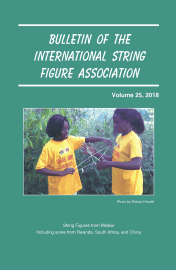
Special Issue: String Figures from Malawi - including some from Rwanda, South Africa, and China
- The String Figures of Malawi by Martin Probert, Alisoun Probert, UK, Richard Hewitt, Samson Phiri, Malawi (pages 1-208) - String figure making is alive and well in Malawi. There is an evolving repertoire of figures named after everyday twenty-first century objects. Highly sophisticated manipulations appear in a number of figures. One hundred and fifteen informants contributed to this 2016-2018 study in which excursions were made to different parts of Malawi, 397 movies made, dozens of photographs taken, six exhibitions held, and detailed interviews recorded with eleven of the informants. Eighty-six string figures were obtained, together with an additional ten minor variants, and a further five figures which appeared under a different name and interpretation. Of the eighty-six figures, eighty have not been recorded in Africa outside Malawi. The collection contains much unique, innovative material. One of the figures might be a survival from the msondo (girls initiation ritual). The informants, one-hundred-and-one female and fourteen male, aged 6 to 60, have been born in, or educated in, 25 of the 28 districts in Malawi. The collection has distinctive features: (i) over two-fifths of the figures are based upon a technique referred to here as the Chishango-technique; (ii) eleven figures represent letters of the alphabet; (iii) almost a third of the figures are derived from ingenious transformations of other Malawian figures.
- Six Rwandan String Figures by Martin Probert, UK, Richard Hewitt, Samson Phiri, Chikondi Medson, Malawi (pages 209-217) - Six Rwandan string figures are collected in 2017 from Aissa Ruberintwari, a pupil of Kamuzu Academy, Mtunthama, Kasungu, Malawi. One of the figures, Rwanda #5, is not known from any previous African collection.
- Two South African String Figures by Martin Probert, UK, Richard Hewitt, Samson Phiri, Malawi (pages 218-219) - These South African string figures were recorded on 3 July 2017 at the National Science Fair, Kamuzu Academy, Malawi.
- A New Chinese String Figure by Martin Probert, UK, Richard Hewitt, Samson Phiri, Malawi (pages 220-221) - This string figure, although well-known around the world, has not previously appeared in BISFA articles on the string figures of China.
Table of Contents - Volume 26 (2019): 231 pages
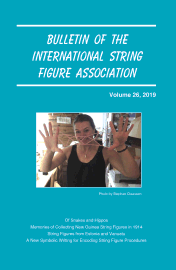
Research Reports
- Of snakes and hippopotamuses, and on the identification of individual string-figure makers from an examination of the historical record by Martin Probert, Plymouth, England (pages 1-6) - We peer back through the mists of time and try to detect the contributions of individual string-figure makers. On the way we investigate two string figures, one of a snake that has come down to us complete with method, the other of a hippopotamus that only exists on a photograph.
- Memories of Collecting New Guinea String Figures in 1914: Excerpts from Kathleen Haddon s unpublished diary by Philip D. Noble, Inverness, Scotland (pages 7-20) - In 1914 Kathleen Haddon and her father Alfred C. Haddon visited British New Guinea to do ethnological research. In this article the author traces their journey along the southern coast and recounts Kathleen s experiences collecting string figures based on her diary entries.
- Kassikangas: String figures in Estonia by Stephan Claassen, Best, Netherlands (pages 21-114) - Twelve different string figures/series and tricks from Estonia are presented. The collection is based on material from the Estonian Folklore Archives (manuscripts that are part of a 1930s game collecting competition and video recordings), on information obtained through the internet, and on material collected by the author himself. There is a considerable amount of variation in string figure making. The most common string game is the two-player game that is known in English as Cat s Cradle, a further common figure is the action figure mimicking the movements of a saw. One short two-player series, a variant of the worldwide known Cat s Cradle game, has probably not been recorded before, which holds also for some variations in the Cat s Cradle game.
- More String Figures from Vanuatu by Thomas Theodore Barnard (1898-1983), and Mark Sherman, Pasadena, California (pages 115-181) - To date, only two collections of string figures from islands in the New Hebrides group (Vanuatu) have been published: Dickey s collection from 1915-17 and Deacon s from 1926-27. In 1923, Cambridge anthropology student T.T. Barnard learned string figures while doing field work at Espiritu Santo in the New Hebrides, but his string figure field notes were never published (except for a pair of three-dimensional figures called The Laia Flower and The Laia Fruit ). Recently, however, it was learned that a typescript summarizing Barnard s collection has been in private hands for many years. The typescript includes instructions for making forty-one string figures learned from informants from four locations, namely, Espiritu Santo, Malekula, Mele (a Polynesian outlier off the coast of Efate), and the Torres Islands in the far north. The typescript is published here, as originally written in Rivers and Haddon nomenclature, for the first time. In a second section of this article the editor provides corrected instructions rewritten in standard ISFA nomenclature, as well as photographs of the final designs extended on the hands. Distribution notes are also included.
- A New Symbolic Writing for Encoding String Figure Procedures by Eric Vandendriessche, Paris, France (pages 182-208) - In this article, we present a new symbolic writing for encoding string figure processes. This coding system aims to rewrite the string figure procedures as mathematical formulae, focusing on the operations implemented through these procedures. This formal approach to string figure making practices has been developed in order to undertake a systematic comparison of the various string figure corpora (at our disposal), and their statistical treatment in particular.
Letters to the Editor (pages 209-215)
- Ztringz: Old Wine in New Bags Becomes a Large Scale Craze! - Stephan Claassen. In December 2018 the author interviewed Michael Brandt, owner of Fun Promotion, a company that markets rainbow-colored string loops ("Ztringz") and creates instructional string figure videos for their Ztringz YouTube channel. Among other things, Claassen learned that at the height of the Dutch Ztringz craze in mid-2018, the company was selling 35,000 Ztringz a week!
- International Workshop in Paris, France - Philip D. Noble. The author shares his impressions of a string figures workshop he attended in May, 2018. It was organized by Eric Vandendriessche, the coordinator of a four-year research project entitled Encoding and Transmitting Knowledge with a String (ETKnoS), which was funded in 2016 by the French National Research Agency (ANR).
Nomenclature - by Mark Sherman (pages 216-231)
- Abbreviations and terms used throughout the Bulletin are summarized and illustrated. Step-by-step illustrations for making five string figures (Look!, Drum, Two Fawns, Face Mask, and Two Arrowheads) are provided as examples.
Table of Contents - Volume 27 (2020): 239 pages

Research Reports
- The knots of neolithic fish-nets by Martin Probert, Plymouth, England (pages 1-3) - Neolithic fish-nets which have been found during excavation utilise one of three distinct ways of joining the separate cords of the mesh: the cord that is passed around the other is given either a simple knot, or a single twist, or a
triple twist. The three types of join are illustrated by the linked strings in the centre of the following string figures.
- A Two Player String Game from Arnhem Land, Australia by Philip D. Noble, Inverness, Scotland (pages 4-29) - This paper describes a two player "take off" string game played by two women from Arnhem Land, Australia, at the Melbourne Museum in 2005. The game was filmed by Judy McKinty. The various moves in the video are tabulated and reference is also made to the interaction between the players as they interact and share ideas of how to continue the series when the sequence appears to be breaking down. In such situations of break down, there is never a sense of criticism implied. It is also recognized that the traditional "taking off" moves demonstrated in the video, while very repetitive, can produce a wide variety of different patterns. It is suggested that this series would be capable of many more variations should a greater variety be performed.
- Playing with the long strings: a structural analysis of Arandic string figures by April Pengart Campbell, Ti Tree, Australia, Stephan Claassen, Best, Netherlands, Jennifer Green, Melbourne, Australia, and Veronica Perrurle Dobson, Alice Springs, Australia (pages 30-136) - Australia is home to a rich and diverse range of Indigenous narrative practices and verbal art forms. These are highly valued and part of the 'intangible cultural heritage' of Indigenous Australians. Making string figures is one such practice, and early records from across the continent suggest that the tradition has a time span that stretches back, at least to the early days of colonization. In this paper we outline some of the sociocultural contexts of Arandic string games from central Australia, and then give a structural analysis of the figures recorded. We look at both similarities and differences in figure construction, comparing the Arandic figures to other records of string figures, both from within Australia and further afield in parts of Oceania. We then apply a formal
analysis, in the string figure tradition, to our collection of Arandic string figures and highlight some figures and methods of construction that appear to be unique to central Australia.
- String Games in Catalonia by Stephan Claassen, Best, Netherlands (pages 137-199) - This paper presents two different string games that are known in Catalonia, along with a description of their context. Comparative remarks accompany each game. The paper is based on previously published information on Catalan string games, information found on the internet, and field recordings made by the author in 2019. The term "string games" is used here instead of the more generally used term "string figures", because in Catalonia the focus is not so much on the actual figures that are being made as on the playful interaction between the players in the game. The Catalan string game corpus consists of one two-player take-over series and one action figure mimicking a saw, but variations do occur. Both are also found in other parts of Europe and the world, although some details are not. The use of the string with which the pastry eaten on festive days is packed is a particular custom in some parts of Catalonia. String games from Basque Country and from the area around Madrid are
presented in appendices, as is an interpretation of a recording of La Scie, a saw-like string figure from France, originally published in 1860 (or 1856).
- A Symbolic Code for Recording String Figure Instructions and an Intersection Diagram Drawing Method: An unpublished Japanese manuscript by
Yasushi Ishida by Naoki Kato, Kanagawa, Japan (pages 200-214) - In this article, I present an English translation of an unpublished manuscript written by Yasushi Ishida. The script described his original symbolic notation and an entirely new string figures diagram. It is also discussed that he was a pioneer in the collection and study of foreign string figures in Japan.
Letters to the Editor (pages 215-223)
- "The String Merels" A Two Player String Game Description from Eastern Thrace - Stephan Claassen. The author provides a partial English translation of a Greek description of the two-player cat's cradle series, written by Callisthenes Hurmuziades and published in 1940-41. Based on Hurmuziades' descriptions the first six stages are believed to be identical with those described by Jayne (1906), but the seventh stage can either be that described by Jayne or an alternative ending that produces a figure called "needles" in English translation, which the author describes how to make.
- International Workshop in ACT, Australia - Philip D. Noble. The author describes a second workshop he attended in June, 2019 on string figure-making practices. It was organized by Robyn McKenzie of Australian National University in collaboration with Eric Vandendriessche, the coordinator of a four-year research project entitled Encoding and Transmitting Knowledge with a String (ETKnoS). The author provides a summary of each day's activities and shares his impressions.
Nomenclature - by Mark Sherman (pages 224-239)
- Abbreviations and terms used throughout the Bulletin are summarized and illustrated. Step-by-step illustrations for making five string figures (Look!, Drum, Two Fawns, Face Mask, and Two Arrowheads) are provided as examples.
Table of Contents - Volume 28 (2021): 227 pages
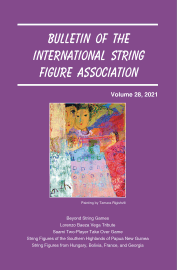
Research Reports
- Beyond String Games by Philip D. Noble, Inverness, Scotland (pages 1-8) - In the past most string figure collectors doing field work have concentrated on recording the method of construction and final design, along with names, meanings, and chants. However, more recently, attention has been given to the context in which string figures are made. The finished string figure pattern is not viewed as something in itself but as part of a procedure for sharing community and fun. Most string figure play appears to be a corporate event even if the designs are being made by one person only. Others watch, advise, copy, and prepare their own versions. Those who seek to gain a deeper understanding of the significance of string figures are advised to be very aware of the whole string figure event from beginning to end.
- Lorenzo Baeza Vega and his Contribution to Kaikai by Marcela Garrido Díaz, Santiago, Chile (pages 9-13) - For many years the location of Lorenzo Baeza Vega s collection of Easter Island string figures, assembled in 1953-1955, has remained unknown. Its last known owner was Baeza s widow, Adriana Mart nez. In this article the author reveals that the collection has at last been located, and digitized to provide free access.
- String Figures of the Southern Highlands of Papua New Guinea by Philip D. Noble, Inverness, Scotland (pages 14-32) - This paper presents fourteen string figures of the Wola from the southern highlands of Papua New Guinea. The figures were collected by Paul Sillitoe in the early 1970s. For three figures Sillitoe did record the construction method, presented here in a modified format. The other eleven are collected as mounted specimens along with a name and a description; for these figures possible construction methods are suggested.
- A Saami two-player take over game, recorded by Yves Delaporte around 1970 by Stephan Claassen, Best, Netherlands (pages 33-54) - This paper presents an interpretation of the two-player take over game, in the English-speaking world often referred to as Cat s Cradle . The game was recorded around 1970 by French ethnologist Yves Delaporte among the Saami of the Kautokeino area in the north of Norway. The presentation is accompanied by short comparative notes. The concept of Stages is introduced to describe the structure of the game. Three transitions between Stages have probably not been recorded in other parts of the world before.
- Hungarian String Figures in Published Sources by Stephan Claassen, Best, Netherlands (pages 55-169) - This paper presents twelve string figures or series of figures, nine tricks, three knots used in folk medicine, one display of skill and one game for children; all are performed with a string loop or a length of string. They were found in publications in the Hungarian language that appeared in the period between 1904 and 2016. Two further examples of the two-player take over game are presented in appendices. The Hungarian string figure corpus clearly fits in the European tradition. Three string figures have probably not been described elsewhere; two of them are closely related to traditional weaving techniques. Some transitions in the two-player take over game were probably not seen before. Some Hungarian string tricks and knots are used in traditional folk medicine.
- Some String Figures of the Moré (North-East Bolivia) as recorded by Emil Heinrich Snethlage in 1934 by Stephan Claassen, Best, Netherlands (pages 170-184) - In November 1934 German ethnologist Emil Heinrich Snethlage filmed the construction of three string figures among the Mor , living on the Bolivian border of Rio Guaporé. The figures are presented here, accompanied by comparative remarks and information on their context.
- La Scie ("The Saw"), a 19th century string figure from France by Stephan Claassen, Best, Netherlands (pages 185-204) - Five independent French sources describe a 19th century two-player string figure called La Scie ("The Saw") or La Scie en Long ("The Pitsaw"). The figure also lends its name to the two-player take over game (called Cat's Cradle in the English-speaking world). The present paper presents the information found in the French sources, along with comparative notes and contextual information.
Letters to the Editor (pages 205-211)
- "Threads", the Two-Player Take Over String Game from Georgia - Stephan Claassen. The author provides a transcription of a video made by artist Tamara Rigishvili of Tbilisi, Georgia, showing how "Cat's Cradle" (the two-player take over game) is played in her country. Attention is drawn to three less common transitions (Stage 6 to 4, Stage 5 to 4, and Stage 5 to 2).
Nomenclature - by Mark Sherman (pages 212-227)
- Abbreviations and terms used throughout the Bulletin are summarized and illustrated. Step-by-step illustrations for making five string figures (Look!, Drum, Two Fawns, Face Mask, and Two Arrowheads) are provided as examples.
Table of Contents - Volume 29 (2022): 251 pages

Research Reports
- A Study of Ladder String Figures: "Twisted-ladders", "Twisted-twisted-ladders", and a new method for increasing steps by Isao Kako, Aichi, Japan; English translation by Kei'ichiro Ishino, Chiba, Japan (pages 1-22) - In this article the author presents newly discovered methods for creating ladder string figures that have 1, 2, 3, 4, 5, 6, or 7 steps. To display the final design many of these ladder string figures require a horizontal 180° rotation of one hand (so-called "twisted-ladders"), or a horizontal 360° rotation of one hand and subsequent crossing of the arms (so-called "twisted-twisted-ladders"). The effects of rotating a partially completed ladder 180 around a vertical axis are also examined.
- A String Figure Collection from Poland by Stephan Claassen, Best, Netherlands, with the help of Agnieszka Kontny, Warsaw, Poland (pages 23-57) - This paper presents six string figures and tricks, and a recording of the two-player take over game. Their construction was shown by Beata Borucka, a lady from Warsaw, Poland, on two YouTube videos. She learnt the figures in the 1960s from her mother, who was from Radzymin, a small town close to Warsaw. The figures are accompanied by comparative notes. They all fit in the European string figure tradition. One figure probably has not been described before, which also holds for some of the transitions in the two-player take over game; they are, however, variants of construction methods that are common in several parts of Europe. Three string figures, recorded in 1940 by Georg Eckert in a Polish workers' community near Le Creusot (central France), are presented in an Appendix.
- A 1939 Collection of String Figures from the North-Western Saami collected by Paul-Émile Victor, presented and annotated by Stephan Claassen, Best, Netherlands (pages 58-90) - This paper presents sixteen different string figures, tricks and knots that were collected in 1939 by Paul-Émile Victor among the north-western Saami. The collection had been offered for publication in a Swedish periodical shortly before WWII, but it was not actually published, in a French periodical, until 1976, when Yves Delaporte prepared Victor's original manuscript. Comparative remarks accompany each figure. Half of the figures/tricks are also found in another collection of Saami string figures, collected some three decades later. Three figures have, as far known, not been recorded before; these are all figures that are constructed mainly on the left hand. Half of the collection consists of tricks. Of these tricks, six have no name. Apparently the Saami themselves do not distinguish between string tricks, knots and string figures. The collection shows characteristics that fit the broader European string figure tradition.
- String Figures from the Saami of Kautokeino collected by Yves Delaporte, presented and annotated by Stephan Claassen, Best, Netherlands (pages 91-118) - This paper presents fourteen different string figures, tricks and knots that were collected between 1969 and 1973 by Yves Delaporte among the Saami of Kautokeino (Norway). The collection was previously published in 1976 on microfilm; it contained also a description of the two-player take over game, which is not presented here but can be found in a previous publication. Comparative remarks accompany each figure. Eight figures/tricks are also found in another collection of Saami string figures, collected some three decades earlier. One figure and two string tricks have, in this form, probably not been recorded elsewhere. More than half of the collection consists of tricks, which are unnamed. Apparently the Saami themselves do not distinguish between string tricks and string figures. The collection shows characteristics that fit the broader European string figure tradition.
- Hunting Frame Strings: Variations of Two Pacific Island String Figures by Cozette Griffin-Kremer, Rambouillet, France (pages 119-137) - In this two-part article the author alters and/or embellishes the construction methods of two traditional Pacific Island string figures ('Milky Way' and 'Kami Moa') to create variations that retain their "frame" (upper and lower transverse) strings. In the first set of variations Opening A is altered, or replaced with a double-walled diamond figure. Methods for altering internal movements and partially deconstructing the finished pattern are also explored. In the second set of variations a "threading" technique is utilized in which finger loops are passed through non-finger loops that are embedded in the partially completed pattern. The final patterns resemble ornate calligraphy.
- String Figures of the Kamoro (West New Guinea) collected by Jan Pouwer (1924-2010), presented and annotated by Stephan Claassen, Best, Netherlands (pages 138-195) - This paper presents a collection of twenty-two different string figures that were collected among the Kamoro (West Papua) in 1954 by Dutch ethnologist Jan Pouwer. No construction methods were recorded. In an Appendix reconstructions for twenty of the figures are presented, of which eighteen are probable. Most figures have been found in other parts of New Guinea and/or Oceania. One figure (likely to be the continuation of another figure) has not been recorded before. The drawings are consistent in that they indicate the use of Opening A* in the construction of the figures, which is an indication that the figures were made by the same informant; this is confirmed by the contextual information.
- Some Tribal String Games from the Plateau Region of British Columbia collected by Frederick W. Waugh (1872-1924), edited and illustrated by Mark Sherman, Pasadena, California (pages 196-219) - Much is known about string figures and tricks made by tribal peoples of the Pacific Northwest Coast culture area of British Columbia, but little is known about what was made by tribal peoples of the adjacent interior Plateau culture area. The small collection presented here, made by anthropologist Frederick W. Waugh in 1916, helps fill the void. It consists of thirteen string figures and four string tricks. Some of the figures and tricks are accompanied by short stories while others are "action" figures where motion is involved. Six of the figures and tricks are also known by the Kwakiutl of the adjacent Northwest Coast culture area. Surprisingly, two figures are classic Navajo string figures from the American Southwest. An action string figure called "Scout" requires the formation of a slip knot and has probably not been published previously.
Letters to the Editor (pages 220-233)
- The Hanapepe Swinging Bridge: A Contemporary String Figure from Hawaii, Invented/Discovered by Juan Wilson - Stephan Claassen. The author provides a transcription of a video made by ISFA members Earl and Lois Stokes of Juan Wilsonan, an architect living in Hanapepe, Hawaii. He shows the construction of an "action" string figure he invented that tells a love story of a couple. They meet at night on a swinging bridge and "kiss".
- Etl-betl: The Yiddish Two-player Take Over Game - Stephan Claassen. In this extensive letter to the editor, the author continues his study of traditional European string games by presenting and annotating previously published descriptions of the traditional two-player take over game as once made by Jewish children in Poland and Galicia (nowadays Ukraine). Names for the game itself, as well as individual stages of the game, are given in both Yiddish and English. A comparison of these names with related names gathered elsewhere in Europe is provided in a table.
Modern String Figures (pages 234-235)
- Winged Heart - invented by Parker Glynn-Adey, Toronto, Canada.
Nomenclature - by Mark Sherman (pages 236-251)
- Abbreviations and terms used throughout the Bulletin are summarized and illustrated. Step-by-step illustrations for making five string figures (Look!, Drum, Two Fawns, Face Mask, and Two Arrowheads) are provided as examples.
Table of Contents - Volume 30 (2023): 263 pages

Commentary
- Strings for String Figures: How to make them by Robin C. Moseley, Elgin, Illinois, USA (pages 1-8) - String fibers, length, thickness, flexibility, and string braiding patterns are essential considerations for best string play. Strings of different properties can be made to best match which figures one might be creating. Additionally, the best string for a specific person varies depending on physical characteristics of one's hands, fingers, arm length etc. Strings made from yarn work well for many string figures, but can be hard to untangle (especially if knots are pulled too tight!), and wear out quickly. Other fibers like hemp are springy, fall off the fingers, and do not conform well to shapes being manipulated. Smaller diameter paracord has many good properties but can be a little too slippery for some figures. Hand woven strings can have a nice feel to the fingers, are pliable when forming string figures, are attractive, but take time and skill to make them. In this article I discuss my experiences making strings with various natural and synthetic fibers using both ready made commercial string and strings hand made by braiding techniques.
Research Reports
- "Grandmother Knits", the Israeli Two-Player String Game by Stephan Claassen, Best, Netherlands and Myriam Namolaru, Haifa, Israel (pages 9-50) - This paper presents Israeli versions of the two-player take over string game, known in the English-speaking world as "Cat's Cradle". It employs fourteen different YouTube videos as its source material. Ten of the transitions found have probably not been described before. Placing a final figure on the head as if it were a crown is also new. In addition, tools (take over techniques, shapes, shape requirements, shorthand descriptions) are developed that can be used in a structural analysis of the game.
- String Figures of the Kauwerawec (West New Guinea) collected by Jan van Eechoud (1904-1958); presented and annotated by Stephan Claassen, Best, Netherlands (pages 51-92) - This paper presents 29 different string figures from the Kauwerawec, a group of people living along the Otken river, a tributary to the Mamberamo river, in western New Guinea. The string figures were recorded by Jan van Eechoud in 1939 in Pionierbivak in 36 black and white photographs, which are reproduced in this paper. Seven of the figures have probably not been seen before, and one figure is only known from another photograph. Four of the figures carry two different names.
- Naught or Knot or Loop by Cozette Griffin-Kremer, Rambouillet, France (pages 93-119) - We often concentrate on making a string figure, but not that often on how we undo it to see what happens as we pull out various strings, so the figures here may involve a complicated process to get to something quite simple, in appearance. After that, we can go on to explore variations through different figures. First, just a word of introduction on the title here: "naught" is when you dissolve, undo a figure, by pulling on strings and have no knot. When you do have a knot, it may be fairly simple or more complex (with more string crossings) and there is a third possibility - when two or more strings loop together.
- Introduction to Two Unpublished Ghanaian String Figures and Discussion of Regional Characteristics collected by
Satoshi Osaka, Kanagawa, Japan; presented and annotated by Naoki Kato, Hyogo, Japan (pages 120-125) - In this article, I present two unpublished Ghanaian string figures collected in 2022 by Satoshi Osaka (then 8 years old), one of the ISFA members in Japan. For one of these string figures ("Drum"), I also discuss the distinctive regional characteristics of the name and explain how its construction method is related to that of the widely known "Four-step Ladder".
- A String Figure Collection from Kuugyuak (Perry River), Nunavut, Canada by Stephan Claassen, Best, Netherlands (pages 126-216) - In 1997 several original inhabitants returned to Kuugyuak (Perry River), a settlement that was abandoned in 1967. They spontaneously started to make and share string figures, which was caught on video tape. The current paper describes 41 out of the 43 string figures and tricks that were shown. The construction of eight figures has not been recorded before, and eleven figures were hitherto not known to be present in the Inuinnait region. It was not possible to identify and transcribe the construction of two of the figures. One of the noteworthy features is the use of the foot in the construction and display of three figures, which is not common for string figures from the Arctic.
Book Reviews - by Mark Sherman (pages 217-219)
- Lorenzo Baeza Vega y el Kaikai by Marcela Garrido Díaz.
Letters to the Editor (pages 220-247)
- İp Oyunu ("String Game"): The Two-player Take Over Game as it is Played in Turkey - Stephan Claassen. The author offers a transcription and analysis of a YouTube video by Sevimce İşler that shows one example of how "Cat's Cradle" is played in Turkey. The short article includes a flow chart and description of six transitions from one stage to another that differ from the standard transitions described by Jayne. Two of the six transitions have probably not been recorded before.
- How Old are String Games? - Philip D. Noble. String figure making is probably one of the oldest pastimes in the world, but no one knows how old. But recently one of the oldest pieces of prehistoric string was found. It was preserved on a flint tool that dates back to around 41,000 to 52,000 years ago, and it was collected from a cave-like rock shelter at the Abri du Maras site level, in southern France, which appears to have been once inhabited by Neanderthals. The author discusses the new find and provides photographs of how such a string might have been made.
- String Figures Workshop, Zürich, 2023 - Philip D. Noble. The author attended an Interdisciplinary Workshop on String Figures, organized by Mareile Flitsch, Mario Schulze, and Sarine Waltenspül, that was held at the Völkerkundemuseum Zürich Switzerland on the 8th to 10th June 2023. He provides summaries of each workshop and speaker presentation and provides 18 photographs that document the event and its participants.
- What Hiroshi Noguchi Left Behind - Tomo Noguchi. Hiroshi Noguchi passed away in 2017. His widow pays tribute to her late husband by describing his Ayatori (string figure) activities since 2006, when he retired from his work for the International Mathematical Olympiad and International Olympiad in Informatics. In that year he again started organizing Ayatori workshops. At first only family members were instructors, but he soon devised a training program for new instructors that culminated with a certification test. With more instructors, he could offer larger and more frequent workshops. Since his passing, his widow Tomo runs the workshops and has written her own Ayatori textbooks. She provides six photographs showing workshop teachers, participants, and two of her textbooks.
Nomenclature - by Mark Sherman (pages 248-263)
- Abbreviations and terms used throughout the Bulletin are summarized and illustrated. Step-by-step illustrations for making five string figures (Look!, Drum, Two Fawns, Face Mask, and Two Arrowheads) are provided as examples.
Table of Contents - Volume 31 (2024): 173 pages

Research Reports
- Swedish String Figures V: String figures from 1970s Stockholm by Stephan Claassen, Best, Netherlands (pages 1-44) - The present paper describes eight different string figures and tricks as they must have been played in Stockholm in the 1970s. They were recorded in the summer of 2023 when a preschool teacher from Stockholm made them for me. The construction of one of the figures has not been described before, and could be the same method as used to make a string figure applied in an early 20th century healing ceremony in southern Sweden. Two figures were known from only one other recording. In the two-player take over game, eight of the transitions have not been described before. One of these transitions was invented by the player herself, and one is not a take over, but a modification of the figure on the hands with the help of the other player.
- Three Ende String Figures and Their Context (Southern Papua New Guinea) by Stephan Claassen, Best, Netherlands (pages 45-58) - The present paper presents three string figures and their accompanying stories as made and told by Kakos Baewa and Winnie Madura. The recordings were made in the village of Limol, South-west Papua New Guinea in 2016. The construction methods and stories (in Ende and in English translation) are presented, accompanied by contextual information and short comparative analyses. One of the figures occurs quite regularly in New Guinea (but not in other parts of Oceania), the two others are much rarer. Two string figure songs (for which the accompanying string figure is unknown) are presented in an appendix.
- Further String Figures from the Faroe Islands by Stephan Claassen, Best, Netherlands (pages 59-71) - During and after a string figure session with elders and children on the Faroe Islands in 2024 six string figures and tricks were collected which were either new to us, were new variants, or had hitherto been uncollected on the islands. These are described in the present paper, accompanied by short comparative notes and analyses. A striking feature of string figure construction on the Faroe Islands is the consistent use of the middle finger instead of the index finger.
- "String Figures of the Congo" Revisited by Mark Sherman, Pasadena, California (pages 72-153) - Ethel M. Smith's collection of Congo string figure instructions was one of the earliest and largest from Africa. Her son, Carey C.K. Smith, edited and illustrated it, and subsequently published it in the 1997 issue of our Bulletin. But recently, a more detailed account of Ethel Smith's collection has surfaced. It is presented here for all to enjoy.
Nomenclature - by Mark Sherman (pages 154-169)
- Abbreviations and terms used throughout the Bulletin are summarized and illustrated. Step-by-step illustrations for making five string figures (Look!, Drum, Two Fawns, Face Mask, and Two Arrowheads) are provided as examples.
Table of Contents - Volume 32 (2025): 189 pages

Masthead
Research Reports
- The Arctic String Figure Project, Part 3: Paterson's Greenland and Canadian Arctic String Figures by Mark Sherman, Pasadena, California (pages 1-77) - Revised methods for making string figures gathered by T.T. Paterson during the Wordie Expeditions of 1934 and 1937 are presented. Unlike the original publication issued in 1949 as part of a comparative study of Eskimo string figures, this revision includes photographs of the finished string figures extended on the hands.
- Jayne in Brief: A Personal Formalization of Jayne's String Figures Using Storer's Calculus by Parker Adey, Toronto, Canada (pages 78-94) - This article uses Tom Storer's string figure calculus to encode the figures in Chapter 2 and 3 of Caroline Furness Jayne's "String Figures". It is intended to supplement Storer's monograph (BSFA 1988:1-410) by presenting familiar figures using the calculus. The aim is both pedagogical and illustrative: to help newcomers become comfortable with the calculus and to demonstrate its expressive
power. The article concludes with a reconstruction of the figure 'Caroline Island Diamonds' using Storer's calculus.
- Some string figures of the Taurepán (Guyana), as recorded by Theodor Koch-Grünberg in 1911 by Stephan Claassen, Best, Netherlands (pages 95-125) - The present paper describes the construction of four string figures as made by a Taurepán boy in 1911. He was filmed by Theodor Koch-Grünberg and Hermann Schmidt when they stayed in the village of Koimélemong on their expedition to the region. For a fifth figure only a couple of stills remain, but it has been possible to reconstruct its construction. Three further Taurepán string figures were preserved as mounted string figures and drawings. Short comparative remarks follow each figure. All figures are, except for small variants, known from published collections from the area. The films are the earliest known filmed field recordings of string figures from the South American continent, and one of the first worldwide.
- String Figures of the Wapishana, as collected and described by William Curtis Farabee by Joseph D'Antoni, Queens, New York, Mark Sherman, Pasadena, California, and Stephan Claassen, Best, Netherlands (pages 126-151) - The paper describes fourteen string figures and tricks of the Wapishana, living in the border areas of Guyana and Brazil. The figures were recorded in 1913 by US anthropologist William Curtis Farabee. Farabee's original written instructions are here interpreted by the three authors and presented in ISFA
nomenclature. They are accompanied by photographs of the final figures, which were largely missing in the original publication. The construction of one figure remains somewhat uncertain; it is further assumed that the instructions for another figure contain a mistake. Apart from that, Farabee's original instructions show to be clearly written.
- An Un-Gordian Knot and Friends: Crossing over, crossing through, knots, naughts, and loops by Cozette Griffin-Kremer, Rambouillet, France (pages 152-168) - The non-traditional string figures presented in this article follow a thread of similar movements in construction. They also consider knots, loops or their absence ("naughts"), as being just as much fun at times as a classic, "completed" string figure.
Book Reviews - by Mark Sherman (pages 169-170)
- String Figures: A Cultural Practice between Art, Anthropology, and Theory edited by Mario Schulze and Sarine Waltenspül.
Letters to the Editor (pages 171-173)
- An Exhibition called "Entwined: String Games Across Cultures" - Alaric Maude. Professor Maude draws attention to an exhibition of his mother's string figures at the University of Adelaide at the end of 2023. It combined exhibits of string figures from various countries, posters on Honor Maude, and items from his father's library which is in the University Library. It was put
together by students in a masters course. The letter includes some photographs taken at the exhibition.
Nomenclature - by Mark Sherman (pages 174-185)
- Abbreviations and terms used throughout the Bulletin are summarized and illustrated. Step-by-step illustrations for making three Inuit string figures (A Hill with Two Ponds, A Mammoth, A Paddle) are provided as examples.
Last updated December 8, 2025
Return to ISFA Home Page.